Steel Hub

Yes. Steel rod quality can vary between heats within the same order, even when every bundle is supplied to the same nominal grade, diameter, and standard. The variation may be small enough to have no effect on a straightforward application, but it can become costly when the rods are welded, cold formed, machined, heat treated, or used in parts with narrow process windows.
For a procurement team, the practical question is not whether every heat will be identical. It will not be. The useful question is whether the permitted heat-to-heat variation is controlled tightly enough for the intended operation, and whether the order documentation allows that variation to be identified before material reaches production.
A purchase order that states only grade, size, quantity, and standard often leaves too much room for interpretation. The material may still comply with the order while producing different results in bending, welding, drawing, or machining. That is why heat control, test certificates, and lot segregation should be treated as purchasing conditions when processing consistency matters.
Why rods from different heats can behave differently
A heat is a defined batch of molten steel made during steelmaking. Its chemical composition is measured and recorded before the steel is cast and rolled. Two heats can both meet the chemistry limits for the same grade while sitting at different points within those limits. Carbon, manganese, silicon, phosphorus, sulfur, residual elements, and microalloying additions may all vary within the allowed range.
That range is normal. Steel standards generally define acceptable boundaries rather than one exact chemical recipe. A rod from one heat may be near the lower end of carbon and manganese allowances, while another is closer to the upper end. Both may pass the material specification, but their response during downstream processing can differ.
Chemistry is only one part of the picture. Rolling temperature, cooling rate, reduction schedule, coil or bar handling, and finishing practice also influence the final structure and properties. Even rods produced from the same heat can show some variation when they are rolled at different times or processed on different lines. Across multiple heats, the potential spread is wider.
For many general fabrication uses, such as simple cut-and-weld work with a suitable welding procedure, standard-compliant heat variation may be manageable. For automatic forming lines, precision fastener production, cold heading, spring applications, induction hardening, or tightly controlled welded assemblies, the same variation can lead to inconsistent production settings, higher scrap, or unplanned qualification work.
Where heat-to-heat variation creates purchasing risk
The most visible risk is mechanical-property variation. Tensile strength, yield strength, elongation, reduction of area, and hardness can move from heat to heat while remaining within the specified acceptance range. If a buyer's process operates close to the upper forming limit or depends on a narrow hardness range, material that is technically compliant may still be operationally unsuitable.
Cold forming is a common example. A rod with slightly higher strength or lower ductility can increase press load, change die wear, or raise the risk of cracking. A cold-heading process is particularly sensitive because surface condition, decarburization, inclusion cleanliness, spheroidizing condition where applicable, and material consistency all affect the result. A grade name alone does not establish that every heat will run equally well.
Welding presents a different concern. Carbon equivalent and residual alloying elements influence hardenability and, therefore, the risk of brittle heat-affected zones or hydrogen-related cracking. A welding procedure qualified on one heat may need more preheat control or different consumable selection for another heat near the upper end of the permitted chemistry range. The effect depends on rod size, restraint, joint design, hydrogen control, and cooling conditions, but buyers should not assume that one mill certificate automatically represents all material in a mixed order.
Machining and heat treatment can also expose differences that are not obvious at goods receipt. Variations in sulfur content, inclusion morphology, prior microstructure, or hardenability may alter chip formation, tool life, distortion, and achieved hardness. Where rods will be converted into safety-relevant or fatigue-loaded components, a broad “meeting standard” statement may not provide enough production assurance.
Surface quality deserves equal attention. Internal chemistry differences are often discussed first, but rod users may face more immediate losses from seams, laps, scale, rust, decarburization, diameter variation, out-of-roundness, or coil handling damage. These issues can differ by heat, rolling campaign, and packaging lot. They are especially important for drawing, threading, peeling, cold heading, and any operation where the surface becomes part of the finished component.
“Same grade” does not always mean “same processing result”
Buyers sometimes assume that a recognized grade designation creates interchangeability across all heats, mills, and shipments. It creates a useful baseline, but it does not eliminate process variation. A standard normally establishes minimum or maximum values for chemistry and mechanical properties, test methods, and dimensions. It may not define the narrower operating window required by a specific production line.
Consider two acceptable heats of the same rod grade. One has mechanical results near the middle of the standard range and a chemistry well suited to the buyer's established welding procedure. The other has higher strength, a different manganese-carbon balance, and results near an acceptance limit. Neither heat is necessarily defective. Yet the second may need slower forming speed, revised weld controls, or additional adjustment in heat treatment.
This distinction matters in commercial discussions. A supplier can reasonably state that material meets the contracted standard if the order has no tighter conditions. The buyer may still bear the cost of process interruptions because the material does not match the behavior expected from earlier deliveries. Preventing that gap requires converting downstream requirements into measurable purchase requirements.
What to specify before placing the order
The appropriate level of control depends on the application. It is unnecessary and expensive to impose highly restrictive heat requirements on rod used for basic fabrication when the process has wide tolerance. It is reasonable to do so when a variation could interrupt a production cell, cause a weld failure, or require requalification.
For orders where consistency matters, purchasing documents should address the following points directly:
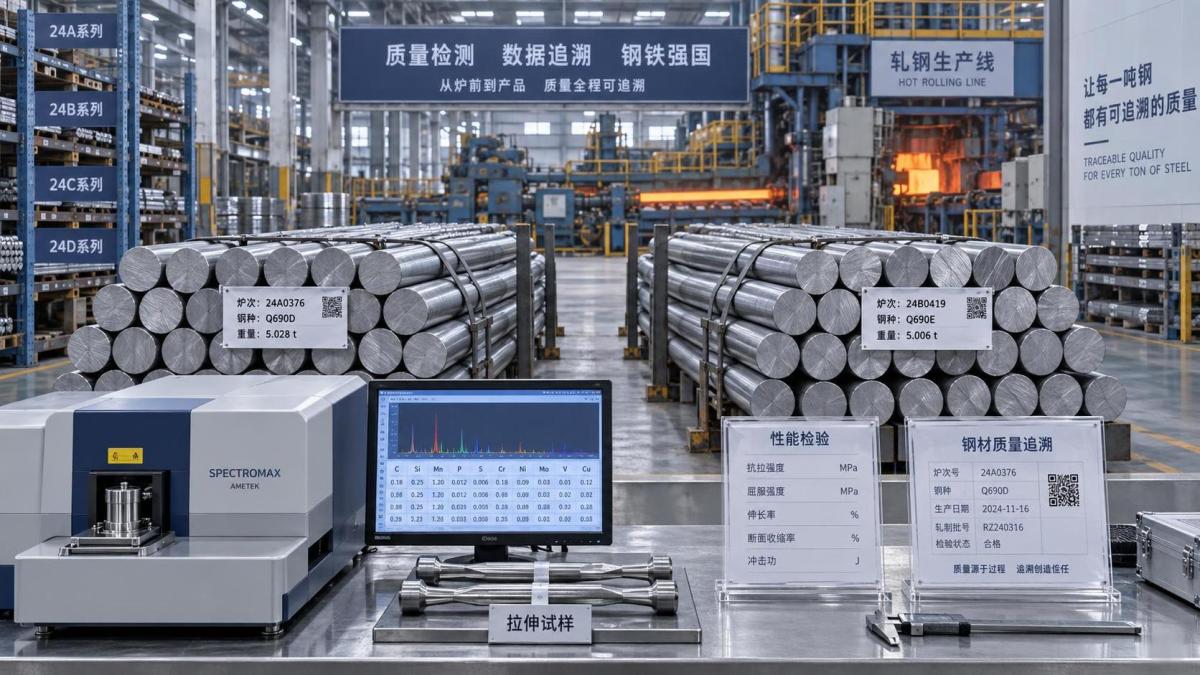
- Heat identification and traceability: Require each bundle, coil, or defined lot to be linked to a heat number. The physical marking, packing list, and test certificate should use the same identification.
- Mill test certificates by heat: Ask for chemistry and mechanical results for each heat supplied, rather than one summary certificate covering a mixed shipment without clear heat allocation.
- Permitted number of heats: State whether multiple heats are acceptable and, if so, set a practical limit per order, per delivery, or per production batch. This is often more useful than asking vaguely for “uniform quality.”
- Supplementary chemistry limits: Where weldability, hardenability, or forming response is sensitive, specify narrower limits for relevant elements or a carbon-equivalent limit where contractually appropriate.
- Mechanical-property window: A purchaser can request a narrower range than the base standard when the process needs it. The requested range must be technically realistic for the grade and production route.
- Surface and dimensional requirements: Define the defects, decarburization limits, scale condition, diameter tolerance, ovality, and straightness or coil condition that the next process can accept.
- Segregated packing: Require heats to be kept separate in packaging and shipping. Traceability has little operational value if material is mixed before it reaches the plant.
- Change notification: For recurring supply, require notice before a change in mill, steelmaking route, rolling route, heat-treatment condition, or agreed inspection practice.
These requirements should be aligned with the actual conversion process. A broad request for “best quality” is difficult to inspect and difficult to enforce. A requirement such as “single heat per production release, heat-specific certificate, controlled mechanical range, and segregated bundles” can be checked at shipment and at receiving.
How to review certificates without treating them as a formality
A mill test certificate is useful only when it corresponds to the material being received and when someone reviews the values that matter to the application. Procurement does not need to duplicate a metallurgical laboratory, but it should establish a routine for checking heat number, grade, size, quantity, chemical analysis, mechanical results, applicable standard, and test condition.
For recurring orders, compare certificates over time rather than reviewing each one in isolation. A result can be compliant yet materially different from previous shipments. Repeated movement toward the top or bottom of a chemistry or tensile range may explain a change in forming load, weld behavior, or machining performance before the issue becomes a larger quality claim.
Certificates should also be checked against the right product condition. A rod supplied as-rolled, normalized, annealed, spheroidize-annealed, pickled, or coated may have different expected properties. Confusion over delivery condition is a frequent source of disputes because the same grade can be purchased for very different downstream purposes.
Where the part or process is high risk, incoming verification may be justified. This could include sampling by heat for dimensions, hardness, tensile testing, bend testing, surface inspection, or a production trial. The right test depends on the failure mode being controlled. Testing every parameter simply adds cost; testing the parameter most closely linked to the next operation provides a more useful control.
When mixed heats are acceptable and when they are not
Mixed heats can be acceptable when the material will be used in a low-sensitivity application, the standard's tolerance range is comfortably inside the processor's operating capability, and traceability is still maintained. In that situation, allowing more than one heat may improve availability, shorten delivery time, or reduce the supplier's production constraints.
They deserve more caution when rods will feed automated cold-forming equipment, tightly qualified welding procedures, controlled heat-treatment cycles, or components with demanding fatigue and reliability requirements. In those cases, a lower purchase price can be quickly outweighed by setup time, rejected parts, additional testing, or a line stoppage. The cost comparison should include conversion risk, not only the price per tonne.
There is also a middle position. A buyer may allow multiple heats in the overall order but require each heat to remain separate and prohibit mixing within a defined production batch. This preserves supply flexibility while allowing manufacturing to track performance and adjust settings at a planned changeover. It is often more practical than insisting on a single heat for a large-volume order.
Build the order around the consequence of variation
Steel rod quality does vary between heats in the same order, and that fact is not automatically a quality failure. The issue becomes commercial and technical when normal mill variation exceeds the tolerance of the buyer's process.
Before issuing the purchase order, identify the downstream operation most likely to be affected: welding, drawing, cold forming, machining, heat treatment, or surface finishing. Then turn that requirement into a limited set of verifiable controls: heat traceability, per-heat certificates, segregation, a defined number of heats, and narrower chemistry or property limits only where they support the process.
That approach gives procurement a clearer basis for comparing offers. A lower-priced order with unrestricted mixed heats may be suitable for one use and unsuitable for another. The better buying decision is the one that matches the permitted material variation to the cost of variation on the production floor.
Please give us a message
Tianjin Kaichuang Metal Material Co., Ltd
Add: No. 41, District 6, First Street, Huanghuadian Town, Wuqing District, Tianjin
Tel: + 86 137 9101 9833
E-mail: boss@kaichsteel.com