Steel Hub

Can a roller leveler eliminate wavy edges in coil, or does the defect require a different correction method? The answer depends on the severity of the edge wave, the steel’s yield strength and thickness, and the leveler’s configuration.
By applying controlled bending, roller leveling can redistribute residual stresses and improve strip flatness, but it may not fully correct severe edge elongation.
Understanding these limits helps technical evaluators assess equipment capability, define realistic flatness targets, and select an appropriate processing solution.
When can a roller leveler correct wavy edges?
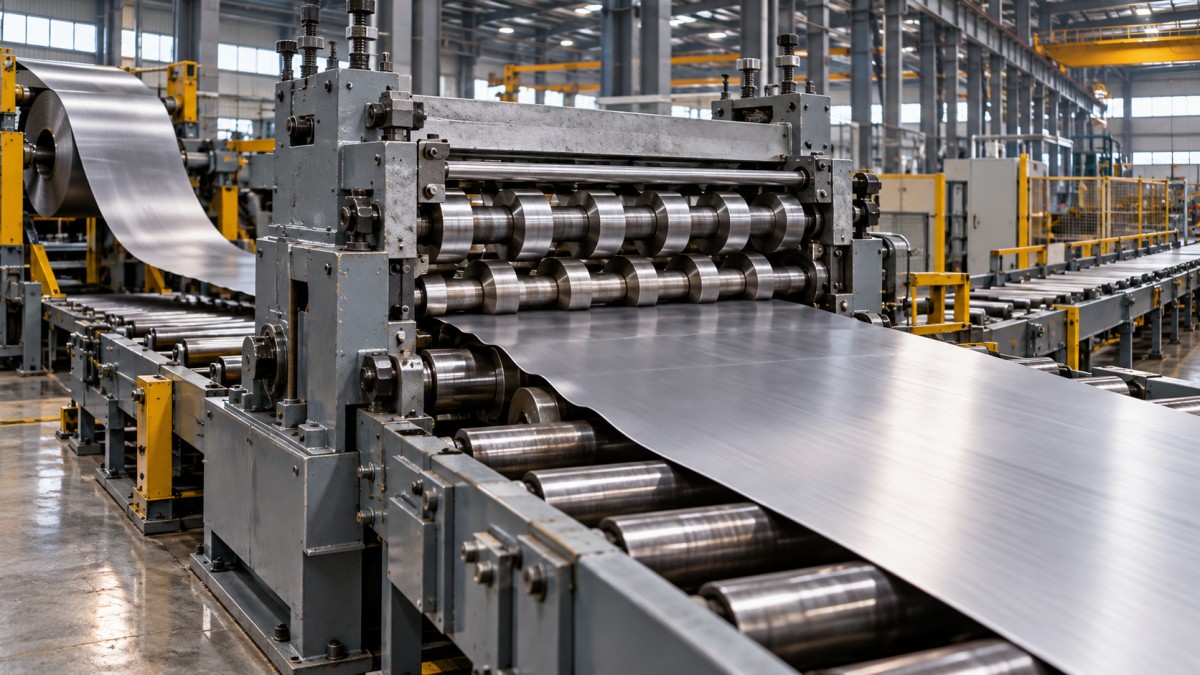
A roller leveler can often reduce moderate edge wave to an acceptable level when its working range matches the material and the process includes effective corrective bending.
Elimination, however, should mean meeting an agreed flatness specification under defined measurement conditions, not assuming that every visible wave disappears in every coil.
For severe edge wave, a conventional leveler may lack the capacity or control needed to compensate for the difference in length between the edges and center.
In those cases, a precision leveler with appropriate roll configuration, tension leveling, upstream rolling adjustments, or edge trimming may be considered, depending on the defect.
The most reliable answer comes from a trial on representative material, with incoming and outgoing flatness measured consistently and downstream performance checked after processing.
What causes wavy edges in steel coil?
Edge wave occurs when the edges are effectively longer than the center of the strip. Because the regions remain connected, the excess edge length appears as waves.
This condition is commonly associated with uneven elongation across the strip width during rolling. Roll deflection, thermal crown, wear, and settings can all contribute.
Residual stresses also influence how the strip behaves after uncoiling, cutting, slitting, or forming. A sheet may look flat while restrained but distort when released.
Evaluators should distinguish edge wave from center buckle, camber, and coil set. These defects have different geometries and may require different corrective settings or equipment.
Edge wave appears along one or both longitudinal edges; center buckle appears in the middle. Camber is a lateral curvature, while coil set is longitudinal curvature.
Multiple defects can coexist in one coil, and their severity can vary along its length. A short sample alone may not represent the entire production run.
How does roller leveling improve strip flatness?
A roller leveler passes strip through a series of staggered rolls, repeatedly bending it in alternating directions. Roll penetration and spacing determine the bending imposed.
When bending produces sufficient plastic deformation through the thickness, leveling can reduce longitudinal stress differences and help establish a more uniform permanent length distribution across the width.
In a suitable machine, roll bending adjustments and support arrangements can help vary the leveling effect across the strip width, addressing differences between edge and center.
As the strip exits, progressively gentler bending can reduce remaining curvature. The resulting flatness depends on the incoming defect, machine setup, and material response.
Not every roller leveler provides the same control. A simple arrangement that removes coil set may have limited ability to correct edge wave across the width.
Leveling also cannot guarantee a distortion-free part after every downstream operation. Cutting or forming can release stresses that were not apparent during the flatness check.
Which material and machine factors determine the result?
Before comparing equipment, establish the full operating range. A machine suitable for mild steel at one thickness may perform differently on thinner or higher-strength material.
Yield strength: Higher-strength grades generally require greater bending capability to achieve plastic deformation. Capacity must be assessed at the actual thickness and width, not by grade alone.
Thickness: Thin strip can be challenging because small roll diameters and close roll spacing may be needed to achieve sufficient bending without damaging the surface.
Thicker strip can demand substantial separating force and drive torque. The machine must maintain its intended roll geometry under load rather than merely accept the material.
Width: Wide strip increases the importance of roll stiffness, backup support, and control across the width. Unsupported roll deflection can reduce correction consistency.
Roll geometry: Roll diameter, spacing, number of rolls, and adjustable penetration affect the available bending cycles. More rolls alone do not guarantee better edge-wave correction.
Support and adjustment: Backup rolls and adjustable roll bending can help control deflection and target cross-width shape, subject to the machine’s design and adjustment range.
Surface requirements: Roll condition, cleanliness, contact pressure, and lubrication practices matter for exposed or coated products. Flatness improvement must not come at an unacceptable surface cost.
Line conditions: Entry alignment, strip tension, speed, and downstream pulling forces affect the process. Test conditions should reflect the intended production line wherever practical.
Request a capability assessment at the most demanding combination of width, thickness, yield strength, and incoming shape, rather than relying on separate maximum values.
How severe is the edge wave, and how should it be measured?
A visual inspection is useful for screening, but an equipment decision requires measurements. Record the wave height, wavelength, location, and frequency along the coil.
Measure on a suitable flat reference surface or with a calibrated flatness system, using a consistent procedure before and after leveling. Record whether the strip is restrained.
For a simple shop-floor description, wave height is the maximum gap between the strip and reference surface; wavelength is the distance between successive wave peaks.
These dimensions help compare samples, but they do not fully describe internal stress or all cross-width shape errors. Avoid treating one height measurement as a complete specification.
Where contract requirements apply, identify the relevant flatness standard, product category, thickness, width, measuring length, and permitted deviation. Do not assume one tolerance covers every grade.
Also define the test condition: coil under tension, free strip after uncoiling, cut sheet on a table, or parts after downstream processing can give different results.
Inspect both edges and the center at several positions along the coil. Mark the samples so incoming and outgoing observations can be matched to the same material.
If slitting follows leveling, check the slit strands after they are released. A wide strip that appears acceptable can reveal residual stress through strand curvature or distortion.
When might roller leveling be insufficient?
Severe differential elongation is a warning sign. The available bending and cross-width adjustment may not produce enough permanent correction without introducing another flatness problem.
A machine may also reach its force limit before achieving effective penetration, especially on high-strength material. Increased settings beyond approved limits can damage rolls or the line.
Overleveling is another risk. Excessive penetration or an unsuitable roll profile can leave coil set, create reverse curvature, mark the surface, or worsen local shape.
Repeat passes may improve a marginal result, but they add handling and cost. Their value should be demonstrated by measurements, not assumed from additional processing.
Some apparent improvement may be temporary if the strip is measured under tension or held flat. Check the released product to confirm that the result persists.
If unacceptable variation recurs across many coils, investigate the rolling process and incoming specification. Downstream correction should not conceal a persistent upstream quality problem.
What alternatives should technical evaluators consider?
Precision roller leveling: A machine with suitable roll geometry, backup support, and cross-width adjustment may correct defects that a basic coil-set breaker cannot adequately address.
This option is worth evaluating when the required flatness is achievable through bending and the product range fits the machine’s force, width, and surface constraints.
Tension leveling: A tension leveler combines controlled strip tension with bending. It can be effective for some strip shape defects, subject to material and line limits.
Tension leveling requires an appropriate line arrangement and sufficient control of strip tension. It may also introduce elongation, so dimensional and surface effects need evaluation.
Rolling-process correction: Adjusting upstream roll profile, crown, cooling, or rolling parameters can address the source of repeated differential elongation when the producer controls those operations.
Edge trimming: Removing affected edges may be practical when the defect is localized and sufficient width allowance exists. It reduces usable yield and does not correct retained material.
No option is universally best. Compare verified flatness, processing capacity, material yield, surface quality, capital cost, and operating cost against the actual product mix.
How to run a meaningful equipment trial
Start by selecting representative coils, including the most difficult grade, width, thickness, and incoming edge-wave severity expected in normal production. Include surface-sensitive products where relevant.
Agree on acceptance criteria before the trial. Specify measurement locations, allowable deviation, test method, sample length, and whether results must be achieved at production speed.
Document the incoming condition with photographs and measurements. Record coil identification and sampling positions so results remain traceable to material and machine settings.
Run the material through the proposed equipment using documented roll settings, tension, and speed. Make adjustments within the supplier’s approved operating limits.
Measure outgoing flatness in the same condition used for the incoming check, then inspect released sheets or slit strands if those forms represent the final application.
Check for surface marks, remaining curvature, and distortion after cutting or forming. A flatness result is incomplete if the process creates a different production defect.
Repeat the trial across relevant coil positions and material combinations. Assess setup time and consistency between operators, not just the best result from one sample.
Finally, compare the outcome with throughput, scrap, maintenance, and changeover requirements. A technically acceptable correction must also work reliably within the intended production schedule.
What should be included in a supplier specification?
Provide grade ranges and yield strengths, strip widths and thicknesses, coil dimensions, surface requirements, and line speed. Identify the combinations that represent the highest demand.
Describe incoming edge wave using measured data and representative samples. State whether center buckle, coil set, camber, or other defects are also expected.
Define the required outgoing flatness and the measurement method, including the product’s restrained or free condition. Include downstream cut-sheet or slit-strand requirements where applicable.
Ask the supplier to explain roll configuration, backup support, adjustment range, force capacity, and expected performance at the demanding combinations in your material range.
Request a documented trial procedure and acceptance plan. Clarify who supplies material, how many samples are tested, and how surface quality and production speed are assessed.
Separate guaranteed performance from estimates. Any guarantee should state its material limits, incoming defect limits, measurement conditions, and the operating settings needed to achieve it.
Conclusion
A roller leveler can eliminate wavy edges in coil to an agreed tolerance when the defect is within the machine’s corrective capability and the material is appropriately processed.
Severe edge elongation, inadequate roll control, or demanding high-strength grades can exceed that capability. In those cases, evaluate precision leveling, tension leveling, upstream correction, or trimming.
For a defensible decision, define the final-product flatness requirement, measure representative incoming material, and verify results through a documented trial under realistic operating conditions.
Please give us a message
Tianjin Kaichuang Metal Material Co., Ltd
Add: No. 41, District 6, First Street, Huanghuadian Town, Wuqing District, Tianjin
Tel: + 86 137 9101 9833
E-mail: boss@kaichsteel.com