Steel Hub

Selecting the right steel tube can directly affect structural reliability, fabrication efficiency, and project cost. In the steel tube ERW vs seamless for structural use decision, technical evaluators must look beyond the simple presence of a weld. The real question is whether the weld line changes the tube’s behavior under the project’s loading, forming, inspection, and service conditions.
For many structural applications, a properly manufactured ERW tube is not a compromise. It is often the more practical and economical choice, with dependable dimensions and strong availability. Yet there are situations where the absence of a longitudinal weld becomes a meaningful engineering advantage. The right answer depends on what the tube will carry, how it will be fabricated, how failure would be managed, and which specification governs acceptance.
ERW and seamless tubes begin with different manufacturing routes
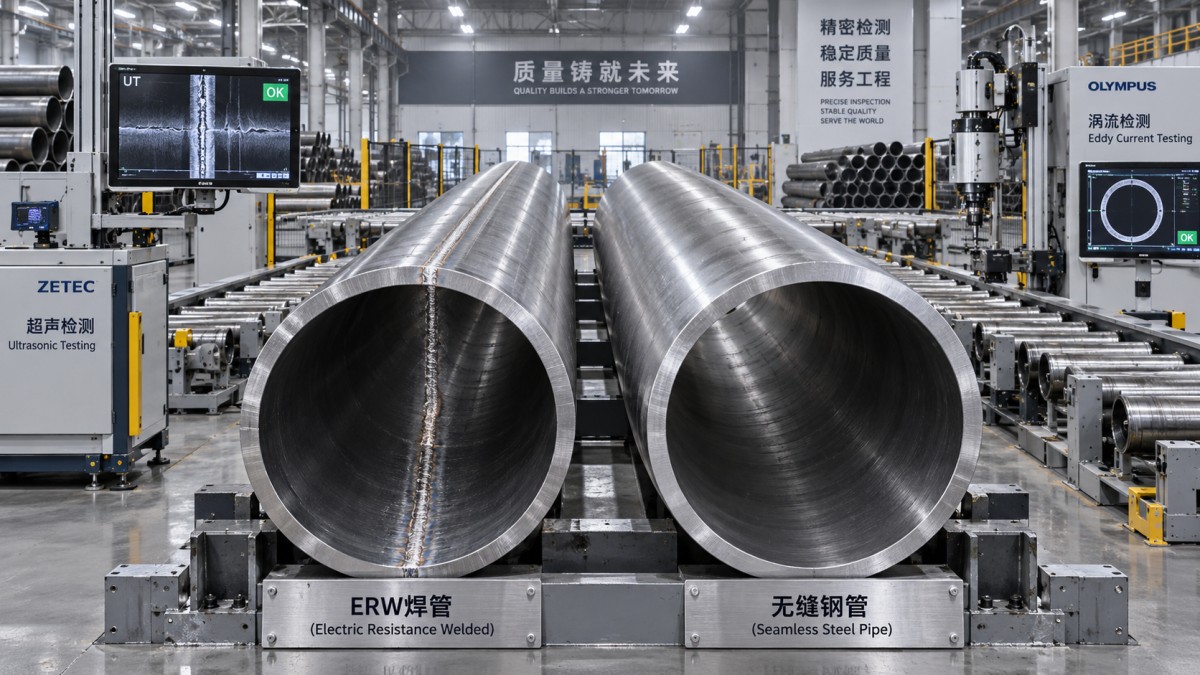
ERW, or electric resistance welded tube, is made from strip or coil. The material is formed into a round shape, its edges are heated by electrical resistance, and the seam is forged together under pressure. The weld is then controlled, scarfed or finished as required, and the tube is sized to its final dimensions. Modern high-frequency ERW production can produce a narrow, consistent weld zone with good mechanical performance when steel chemistry, forming, and process control are properly managed.
Seamless tube begins as a solid billet. The billet is pierced and elongated through hot-working processes to create a hollow shell, then rolled, sized, heat treated, and finished according to the required grade and tolerance. Because there is no longitudinal fusion line, the tube has a continuous wall around its circumference.
That distinction matters, but it should not be exaggerated. Seamless does not automatically mean stronger in every structural role, and ERW does not automatically mean unsuitable for demanding work. Product performance is shaped by grade, wall thickness, heat treatment, dimensional control, testing, and the quality requirements written into the purchase order.
The weld matters most when stress concentrates at the seam
In ordinary compression members, building frames, handrails, secondary steelwork, racking, agricultural equipment, and many fabricated assemblies, the tube wall usually shares load around the full section. If the ERW tube meets the specified structural standard and mechanical properties, its weld seam may have little practical effect on the design outcome.
The evaluation changes when the seam is exposed to a severe combination of stress, deformation, fatigue, corrosion, or inspection limitations. A longitudinal weld can become relevant when the tube is repeatedly bent, flattened, expanded, swaged, or subjected to cyclic pressure and vibration. It also deserves closer attention when the seam orientation cannot be controlled relative to principal bending stress.
Consider a tubular brace carrying mostly axial load in a controlled indoor structure. An ERW product made to the appropriate hollow-section standard will commonly be suitable. Now consider a highly loaded hydraulic cylinder component, a deep-drawn part, a thin-wall tube that will be aggressively flared, or a member exposed to persistent cyclic loading near a corrosive interface. In these cases, the manufacturing route and seam quality deserve a more rigorous review.
A practical comparison for structural evaluation
The table is a starting point, not a substitute for design verification. For a structural evaluator, the critical task is to translate the application into measurable acceptance criteria instead of specifying “seamless” simply because it feels safer.
When ERW is usually the rational choice
ERW tube is widely used because it fits the needs of routine structural fabrication remarkably well. It is particularly appropriate when the design is governed by standard section properties, static or moderate loads, predictable fabrication steps, and recognized structural tubing requirements.
For fabricated building members, equipment frames, solar support systems, truck bodies, scaffolding components, furniture structures, conveyor supports, and many mechanical assemblies, ERW can offer a useful balance of strength, dimensional repeatability, and material efficiency. The consistent outside diameter and wall thickness available from controlled ERW production can also simplify cutting, fit-up, fixture design, and automated welding.
ERW is especially compelling when the project calls for a large range of standard sizes. Coil-based production supports efficient supply of common diameter and thickness combinations, helping manufacturers avoid paying for seamless capacity that provides no functional benefit in the finished component.
However, “ERW is acceptable” should always mean more than “a welded tube was available.” Confirm the governing standard, steel grade, yield and tensile requirements, elongation, dimensional tolerance, and testing provisions. If the tube will be hot-dip galvanized, bent after delivery, laser cut near the seam, or welded into a critical assembly, those operations should be discussed with the supplier before production begins.
When seamless tube earns its added cost
Seamless tube becomes more attractive when the design cannot comfortably accommodate uncertainty around a longitudinal weld zone, even if that uncertainty is small. This may include components exposed to high internal pressure, severe thermal cycling, demanding fatigue duty, aggressive cold forming, or machining that removes a significant portion of the wall in a localized area.
For structural use specifically, seamless can be justified in heavily stressed mechanical members, offshore-related equipment, specialized lifting or drilling components, high-consequence machinery, and assemblies where the tube is both a structural element and a pressure-retaining or motion-transmitting part. The case becomes stronger if the member will experience multi-directional loading that is difficult to model, or if in-service inspection access will be limited.
Seamless tube may also be selected where a customer specification, regulatory code, or end-user approval explicitly requires it. In that situation, the decision is not merely a technical preference; it is a compliance requirement. Substituting ERW without formal approval can create documentation problems even where mechanical calculations suggest comparable performance.
Still, seamless should not be treated as a blanket risk-removal tool. It can contain imperfections associated with piercing, rolling, or finishing, and it must be purchased with the same discipline applied to any critical material: clear standard references, inspection scope, heat-treatment requirements, chemical limits, and traceable certification.
Do not evaluate the weld in isolation
A frequent mistake in the ERW versus seamless discussion is to focus only on the seam while overlooking the rest of the tube specification. A seamless tube with unsuitable chemistry, poor straightness, insufficient wall tolerance, or incomplete traceability is not a better structural solution than a properly controlled ERW product.
For an informed comparison, technical teams should review the following questions together:
- What is the primary load mode? Axial compression, bending, torsion, impact, pressure, and fatigue do not place the same demands on a tube.
- Will the tube be formed after purchase? Tight-radius bending, flattening, end expansion, and deep swaging can make seam performance more important.
- Where will the seam sit in the final part? If orientation matters, determine whether the fabrication process can identify and control it.
- What is the failure consequence? A non-critical bracket and an inaccessible safety-related component should not be specified with the same margin philosophy.
- Which standard applies? Structural hollow-section standards, mechanical tubing standards, and pressure-tube standards are not interchangeable simply because dimensions appear similar.
- What inspection evidence is needed? Mill test certificates, weld testing, ultrasonic examination, eddy-current testing, hydrostatic testing, or third-party inspection may be relevant depending on the application.
Standards, certificates, and wording that prevent costly ambiguity
Technical evaluators often inherit vague requests such as “carbon steel tube, seamless preferred” or “welded tube acceptable.” Those phrases are too broad for purchasing, quality, and fabrication teams to interpret consistently. A better material callout defines the product form, governing standard, grade, dimensions, tolerance class, delivery condition, test requirements, and documentation level.
For ERW tube, specify whether the weld must be normalized, heat treated, or subject to non-destructive examination where applicable. Clarify whether weld flash removal is required on the inside, outside, or both. This can affect fit-up, fluid flow, machining, and coating performance. For seamless tube, define whether hot-finished or cold-drawn condition is needed, as well as any surface-quality restrictions important to the finished part.
Traceability deserves equal attention. Heat numbers, mill test certificates, and linkage between received bundles and fabricated parts are valuable whenever material performance may later be questioned. In supply chains serving construction, transport equipment, shipbuilding, energy, or industrial machinery, a clear document trail often saves more time than it costs.
Watch for these misleading shortcuts
“A weld always makes the tube weaker.”
Not necessarily. A controlled ERW weld can meet or exceed the required properties of the base material in relevant tests. The engineering issue is whether the finished tube complies with the intended standard and whether the application imposes conditions that make seam behavior critical.
“Seamless is always better for fatigue.”
Fatigue performance depends on many factors: geometry, surface condition, residual stress, corrosion, weld attachments added during fabrication, stress range, and load cycles. A seamless wall removes one potential longitudinal feature, but it does not eliminate fatigue risks created elsewhere in the assembly.
“Any pipe can serve as structural tube.”
Pipe and structural tube may share dimensions, but their standards and intended performance can differ. A pipe selected primarily for fluid conveyance may not provide the section tolerances, mechanical properties, or certification required for a load-bearing frame.
“The lowest material price determines the best option.”
The relevant number is installed cost and lifecycle risk. A less expensive ERW tube may reduce procurement expense and fabrication time. Conversely, choosing ERW for a severe forming operation that later produces seam-related rejects can erase those savings quickly. Seamless should likewise be challenged when its premium does not improve the final component’s function.
A decision path for the steel tube ERW vs seamless for structural use question
Begin with the governing design and service requirements rather than the manufacturing label. If the application is a conventional structural member operating within a recognized hollow-section specification, ERW is often the logical baseline. Verify the grade, wall thickness, weld quality provisions, and tolerances; then assess whether fabrication introduces unusual seam sensitivity.
Move toward seamless when the tube will undergo severe deformation, operate under high pressure or intense cyclic service, perform a safety-critical mechanical role, or face a specification that explicitly excludes welded product. If the decision remains uncertain, compare representative samples through the actual fabrication route—not only through catalog data. Bend trials, flattening tests, machining evaluation, and targeted non-destructive examination can reveal whether a theoretical concern is relevant to the real part.
The most reliable choice is rarely driven by the word “welded” or “seamless” alone. It comes from matching steel tube production method, material specification, verification level, and fabrication process to the consequences of failure. When that match is made carefully, ERW can be an efficient structural solution, while seamless can be reserved for the conditions where continuous-wall performance genuinely matters.
Please give us a message
Tianjin Kaichuang Metal Material Co., Ltd
Add: No. 41, District 6, First Street, Huanghuadian Town, Wuqing District, Tianjin
Tel: + 86 137 9101 9833
E-mail: boss@kaichsteel.com