Steel Hub

Is weathering steel suitable for outdoor structures near the coast?
Weathering steel can offer durable, low-maintenance performance outdoors, but coastal exposure can undermine the protective patina that makes it effective. For engineers assessing weather resistant steel for outdoor structures, suitability depends on airborne chloride levels, wet–dry cycles, drainage, and sheltered areas where salt and moisture accumulate—not simply distance from the shoreline.
The practical answer is conditional: uncoated weathering steel may be viable in some coastal locations, but direct sea spray, persistent dampness, and salt-retaining details are strong reasons to consider a different protection strategy. Specifying a weathering grade does not, by itself, establish that a structure can safely remain unpainted.
The limitation is the exposure, not just the steel grade
Weathering steel contains alloying elements that help a relatively adherent rust layer develop under suitable atmospheric conditions. This patina can slow subsequent corrosion compared with ordinary carbon steel in the same environment. It is not a waterproof barrier, and the material is neither rustproof nor equivalent to stainless steel.
Alternating wetting and drying supports protective patina development. Coastal salts can disrupt that process. Chloride-containing deposits retain moisture and promote corrosion beneath the rust layer, particularly where surfaces dry slowly. A surface may therefore look convincingly brown while continuing to lose metal at an unacceptable rate.
That distinction matters when assessing existing structures. Rust colour alone cannot confirm acceptable performance. Persistent damp patches, loose or layered rust, localized pitting, and measurable section loss deserve more attention than whether the finish has achieved a uniform architectural appearance.
Increasing plate thickness is not a substitute for resolving unsuitable exposure. A corrosion allowance may form part of an engineered design, but it needs a defensible loss estimate and cannot automatically address concentrated attack at connections or water traps.
Why a shoreline setback is not enough
Distance from the sea is useful screening information, not a complete acceptance criterion. Salt transport varies with prevailing winds, surf conditions, topography, elevation, and surrounding buildings. A relatively exposed site farther inland may receive more airborne salt than a sheltered location closer to the water.
Even within one structure, exposure can differ sharply. Rain-washed external faces may perform differently from the underside of a canopy. Sheltering reduces direct rainfall, but it can also prevent deposited salts from being washed away. Condensation can then repeatedly wet those deposits.
For an initial assessment, separate these conditions rather than assigning the whole project a single “coastal” label:
- Direct marine exposure: breaking-wave spray, tidal wetting, splash, or repeated saltwater contact. These are strong reasons to reject an uncoated atmospheric-weathering approach.
- Airborne salt exposure: no direct seawater contact, but chloride deposition may still compromise patina performance. Site evidence becomes essential.
- Salt-retaining microclimates: sheltered joints, horizontal ledges, damp bases, and enclosed spaces. These may control durability even when the surrounding atmosphere appears manageable.
Road-deicing salts, where used, are another possible chloride source. A coastal bridge or roadside structure may face both marine aerosols and contaminated runoff; assessing only the sea-facing elevation would miss part of the problem.
Build the decision around evidence from the site
Before approving uncoated weathering steel, establish what the material will actually experience. Useful inputs include local wind and rainfall records, airborne chloride measurements, humidity and condensation conditions, drainage arrangements, and the condition of comparable nearby steelwork. Nearby structures provide context, but differences in grade, age, geometry, and maintenance limit direct comparisons.
ISO 9223 provides a framework for classifying atmospheric corrosivity. ISO 9225 addresses measurement of environmental parameters, while ISO 9226 covers determination of corrosion rates using standard specimens. These can support an exposure assessment, but a corrosivity category is not, on its own, approval to use a particular weathering steel uncoated.
Where uncertainty could change the material decision, site monitoring or exposure testing is worth considering. The programme should capture relevant seasonal variation and representative locations, including sheltered areas. Short-term coupon results should not be extrapolated mechanically across the design life: corrosion behaviour can change as rust develops, and standard specimens do not reproduce every structural detail.
The assessment should lead to an explicit decision: accept uncoated steel under defined conditions, require protection, select another material, or gather further evidence. Leaving the conclusion as “weathering steel is generally suitable outdoors” transfers unresolved risk into fabrication and maintenance.
Details can defeat an otherwise reasonable material choice
Consider a coastal canopy with open, ventilated columns but upward-facing channels beneath the roof. The columns may dry readily while the channels collect salty dust, condensation, and debris. Using the same grade throughout does not make those components equally durable.
Detailing should make water leave the structure and allow wet surfaces to dry. Avoid pockets at stiffeners, poorly drained base plates, and narrow gaps that collect debris. Connection geometry should allow inspection and cleaning rather than hiding the locations most likely to corrode.
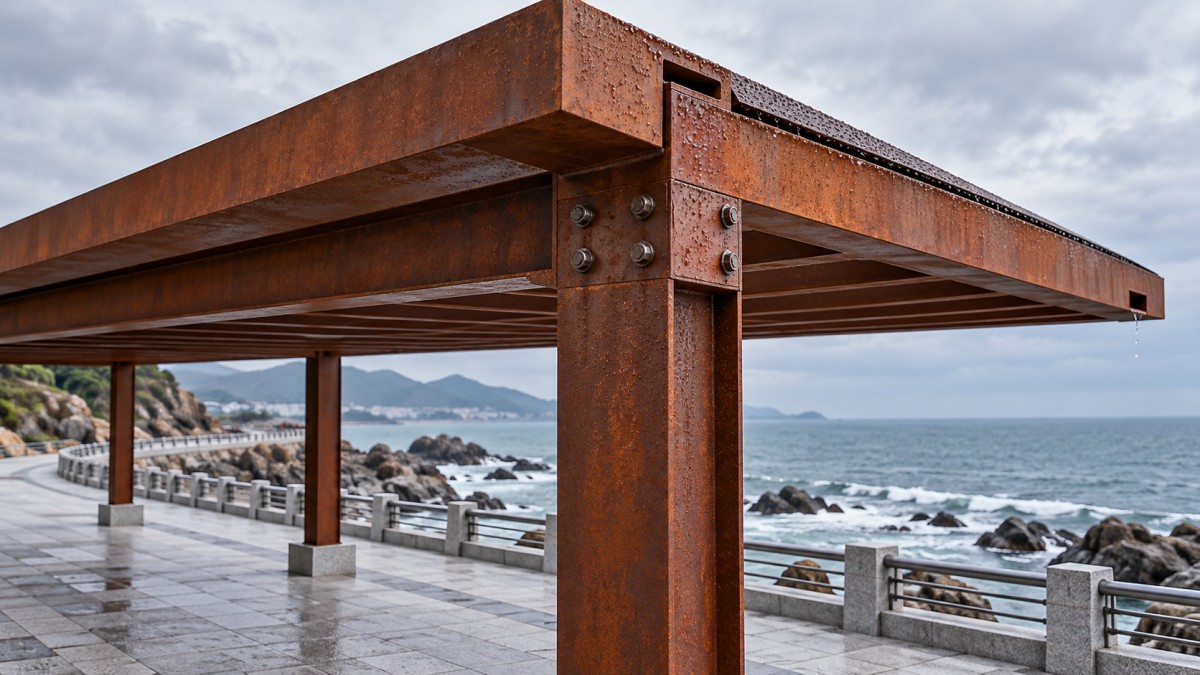
Hollow sections need a deliberate internal-corrosion strategy. Where sealing is intended, the fabrication specification and inspection must support it. Where openings are necessary, drainage, ventilation, and water-entry paths need coordinated design. Small, accidental openings are not a reliable ventilation system.
Bolts, weld consumables, and adjacent metals also require review. Select fasteners and consumables for the specified structural system and exposure; do not assume any high-strength bolt or filler metal provides suitable weathering behaviour. Dissimilar-metal interfaces may need isolation, especially where saltwater can act as an electrolyte.
Rust-laden runoff is a separate serviceability issue. It can stain concrete, stone, paving, and glazing below the steel. Drip details and controlled discharge paths should be resolved before installation, particularly where public-facing finishes make later staining unacceptable.
When coatings or another material make more sense
Uncoated weathering steel deserves consideration where chloride exposure is sufficiently low, surfaces can dry, and inspection remains practical. Its strongest case is not simply avoiding the initial painting cost; it is avoiding repeated coating work without accepting excessive section loss.
If salt exposure is significant or uncertain, compare complete protection systems rather than bare steel prices:
- Coated carbon steel: often a practical baseline when marine exposure requires a designed barrier system. Surface preparation, edge treatment, application conditions, and future access are central to performance.
- Coated weathering steel: can be considered, but its additional material cost needs justification. Weathering alloy content does not remove the need for proper coating design and maintenance.
- Galvanized or duplex-protected steel: may suit selected components. Check exposure severity, expected zinc consumption, fabrication constraints, and compatibility with the required service life.
- Appropriately selected stainless steel: may be justified for difficult-to-maintain or chloride-sensitive details. Grade selection still matters because stainless steel can suffer pitting and crevice corrosion in marine conditions.
The comparison should include installation access, disruption during maintenance, inspection costs, and consequences of localized failure. A higher initial material cost may be reasonable for an inaccessible connection, while a maintainable coating system may be more economical for a large, accessible frame.
Translate the exposure decision into procurement requirements
“Weather resistant steel for outdoor structures” describes an intended application, not a complete purchase specification. Standards such as ASTM A588/A588M and EN 10025-5 address defined weathering steel products and properties; compliance does not guarantee suitability for every coastal atmosphere.
Specify the grade, product form, dimensions, mechanical properties, toughness requirements where applicable, and inspection documentation. Plate, rolled sections, and hollow sections may have different availability and applicable product standards. Confirm that the proposed material satisfies the structural design rather than treating weathering grades as interchangeable.
This is also a supply-chain decision. Steelmaking and rolling routes, mill production schedules, available thicknesses, and fabrication capabilities affect delivery. A readily available weathering plate does not establish that matching sections or compatible fasteners will arrive on the same programme. Resolve substitutions before fabrication, not when material shortages force an improvised change.
If a pre-weathered appearance is specified, distinguish that cosmetic requirement from corrosion performance. An accelerated surface treatment does not demonstrate that the finished component will develop a protective patina under coastal service conditions.
Approve the inspection plan alongside the material
Low maintenance should not mean no inspection. Establish baseline photographs and thickness records at selected locations, then set inspection intervals according to exposure, structural consequence, and observed behaviour. Connections, bases, sheltered undersides, and drainage outlets deserve particular attention.
Define what will trigger intervention: blocked drainage, persistent wetness, significant rust layering, pitting, or section loss beyond the engineer’s acceptance criteria. Any cleaning or washing plan should include safe access and runoff management; it should not be an undefined promise used to justify unsuitable exposure.
For a coastal project, the defensible choice is the one supported by measured or otherwise credible exposure evidence, workable details, and an achievable maintenance plan. If those checks cannot support an uncoated design, choose a protection system before procurement rather than waiting for the patina to prove the assumption wrong.
Please give us a message
Tianjin Kaichuang Metal Material Co., Ltd
Add: No. 41, District 6, First Street, Huanghuadian Town, Wuqing District, Tianjin
Tel: + 86 137 9101 9833
E-mail: boss@kaichsteel.com