Steel Hub

Which steel wire coatings resist salt spray in coastal environments?
Hot-dip zinc, zinc-aluminum alloys, and polymer-over-metal systems are the main coating options for steel wire exposed to coastal salt spray. All can be suitable, but they are not interchangeable. A coating that performs well on straight wire may behave differently after tight bending, mesh welding, or repeated rubbing against a support.
For evaluators asking what coating options exist for steel wire in coastal environments, the useful comparison is not simply “which survives the most salt spray hours?” It is which system retains enough protection after manufacturing, installation, and service exposure. Coating mass, continuity, adhesion, and damage tolerance matter alongside the corrosion test result.
Start with the exposure—not the distance from the shoreline
“Coastal” can describe an open fence that dries in the wind, a shaded cable support beneath a pier, or mesh repeatedly wetted by breaking waves. These are different corrosion environments. Salt deposits attract moisture, while sheltered locations may receive little rain washing. A component protected from direct spray can therefore remain contaminated and damp for longer than expected.
Before comparing coatings, establish whether the wire faces airborne salt, direct splash, tidal wetting, or immersion. Also identify abrasion, contact with soil or concrete, trapped moisture at clamps, and access for inspection. Atmospheric test evidence alone is not enough to qualify a system for tidal or continuously submerged service.
The product form changes the decision too. Static fence wire, woven mesh, spring wire, and moving wire rope do not impose the same demands. A thick polymer jacket may suit a stationary barrier but be inappropriate where bending fatigue, lubrication, or internal strand inspection governs performance.
Hot-dip zinc: a practical baseline, provided the coating survives fabrication
Zinc protects steel in two ways: it separates the surface from the environment and provides sacrificial protection where small areas of steel become exposed. This damage tolerance is valuable for wire products, where cut ends, handling marks, and contact points are difficult to eliminate completely.
For coastal atmospheric exposure, a suitably heavy hot-dip zinc coating is generally a more credible starting point than thin electrogalvanizing. Electroplated zinc can provide a smooth finish and dimensional control, but a thin deposit offers limited corrosion reserve. “Galvanized” on a quotation does not tell you enough: request the process, minimum coating mass, applicable wire diameter, and acceptance standard.
ASTM A641/A641M is one relevant specification for zinc-coated carbon steel wire. Where applicable, EN 10244-2 addresses zinc and zinc-alloy coatings on steel wire. Neither should be treated as a blanket coastal service-life guarantee. The specified coating requirements and the condition of the delivered product still need checking.
The manufacturing route deserves attention. Wire coated before subsequent drawing or forming may have a different surface condition from wire coated at its final size. In welded mesh, welding after coating can locally disrupt protection; coating after fabrication introduces different requirements for coverage and drainage. Ask the supplier to identify the sequence rather than assuming equivalent performance.
More zinc is useful only while it remains attached. Tight bends, twisting, and unsuitable forming conditions can cause cracking or flaking. For a heavily formed component, a representative wrap or bend test may reveal more than another test on an untouched straight sample.
Zinc-aluminum alloys: often worth evaluating for exposed coastal wire
Zinc-aluminum coatings are widely used where conventional zinc protection needs upgrading. Their corrosion products and coating structure differ from those of essentially pure zinc, and suitable formulations can outperform conventional zinc in comparative chloride-exposure testing. That makes them credible candidates for coastal fencing, mesh, and other stationary wire products.
However, “zinc-aluminum” is a family description, not a complete specification. Around 5% aluminum and higher-aluminum formulations are available, sometimes with additional alloying elements. Do not assume that increasing aluminum content automatically improves every aspect of performance. Corrosion behavior, formability, coating uniformity, and manufacturing control must be considered together.
ASTM A856/A856M covers zinc-5% aluminum-mischmetal alloy-coated carbon steel wire. A supplier offering a different composition should identify the appropriate specification and supporting evidence rather than relying on a familiar alloy label.
Compare candidates at clearly stated coating masses and wire diameters. A result from a heavier alloy coating does not isolate the benefit of alloy chemistry. Likewise, because coating density varies with composition, equal mass per unit area does not necessarily mean equal physical thickness. Ask for both where thickness affects fit or forming.
For installations that are difficult to maintain, an alloy coating may justify a higher initial cost. The useful evidence is performance on the supplied wire after the intended fabrication steps—not an impressive result obtained on a different product.
Polymer over a metallic coating: stronger separation, more attention to defects
A polymer layer over galvanized or zinc-alloy-coated wire adds a barrier against salt and moisture. PVC and polyethylene are established options for certain fence and mesh products; other polymers may suit specific temperature, chemical, or mechanical requirements. The metallic underlayer remains important because the polymer will not necessarily stay damage-free throughout installation and service.
This layered approach is attractive where visual finish matters or salt deposition is persistent. But the coating name alone says little about outdoor durability. UV stabilization, flexibility, adhesion, temperature range, and resistance to abrasion all depend on the formulation and application process.
A common weak point is a damaged jacket at a cut end, clamp, or bend. Moisture can enter and remain beneath a poorly bonded layer, hiding corrosion from routine visual inspection. A thicker polymer coating does not compensate for poor adhesion or discontinuities.
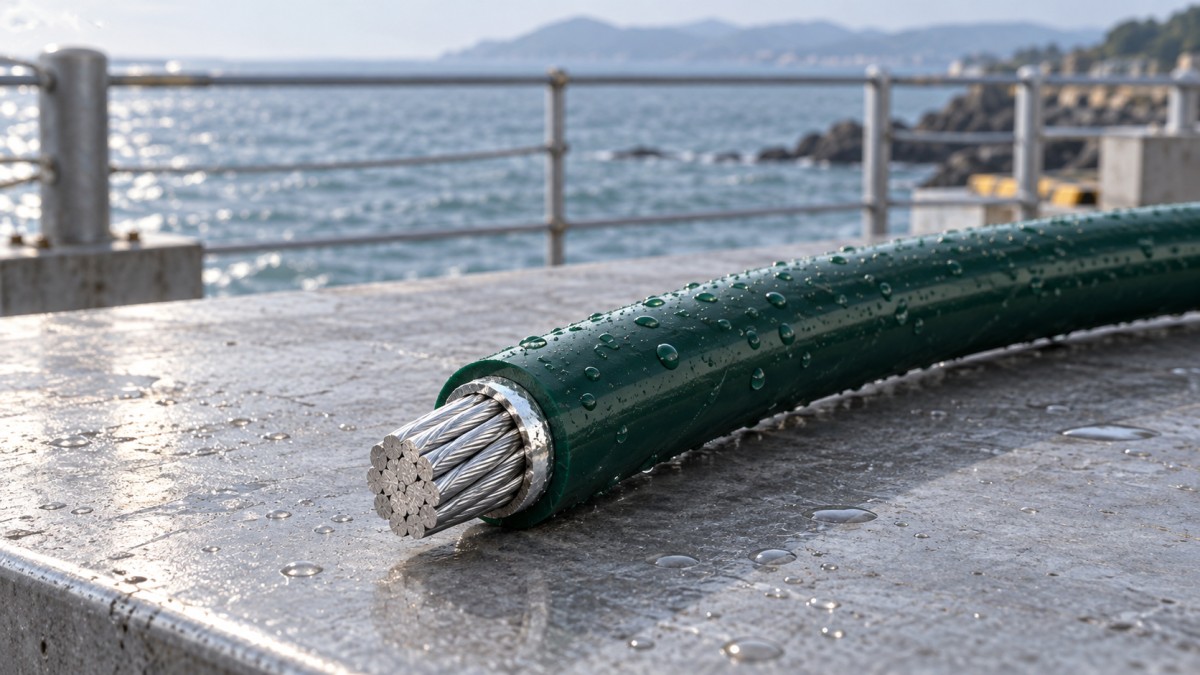
Evaluate the complete cross-section: steel core, metallic coating, and polymer jacket. Ask how continuity is checked, whether the jacket remains sound after bending, and how exposed ends are treated. Where electrical holiday testing is appropriate, its method and settings should suit the particular coating system; an unsuitable test can miss defects or damage the jacket.
For mesh dragged over rough ground or tightened against sharp brackets, installation damage may dominate the outcome. Better handling and compatible fittings can be more useful than specifying extra jacket thickness without changing the installation method.
What salt spray results actually tell you
ASTM B117 and ISO 9227 are commonly referenced for salt spray testing. They define controlled test conditions; they do not provide a universal conversion from chamber hours to years beside the sea. Continuous laboratory exposure also differs from outdoor wetting, drying, sunlight, and rain washing.
The endpoint matters. White corrosion products on zinc are not the same as red rust from the steel substrate, although their formation can indicate consumption of the protective coating. “No rust” is ambiguous unless the report defines what was assessed, over what area, and at which locations.
Before accepting a comparison, check:
- Whether specimens were straight, bent, welded, scratched, or otherwise representative of the finished product.
- Whether cut ends were sealed and whether corrosion at ends or fixture contacts was excluded.
- The coating mass or thickness, alloy composition, and any passivation or sealing treatment.
- The failure criterion, specimen count, and consistency of results—not just the best photograph.
Cyclic corrosion testing and relevant outdoor exposure data can add useful context. Neither removes the need to examine mechanical damage. A coating that wins on undamaged samples may lose its advantage after the actual forming operation.
Turn the comparison into a purchase specification
A workable specification separates steel properties from corrosion protection. State wire diameter, tensile requirements, and forming needs alongside the coating system. The steelmaking and wire-rod supply route supports the required mechanical properties, but those upstream controls do not establish the durability of the final coated surface.
Specify minimum coating mass or thickness, applicable test methods, adhesion requirements, and acceptance after representative forming. For polymer-coated wire, distinguish the steel core diameter from the finished outside diameter. Otherwise, two apparently equivalent quotations may contain different load-bearing steel sections.
Request traceability between qualification samples and production material. Changes in wire diameter, coating line, alloy composition, or polymer formulation may affect whether an earlier report remains relevant. Packaging also deserves a requirement: salt contamination, wet storage, and abrasion during transport can compromise the starting condition before installation.
For accessible, moderately exposed installations, heavy hot-dip zinc may be a sensible baseline. For more persistent coastal atmospheric exposure or costly replacement access, compare a defined zinc-aluminum coating against it. Where an additional barrier is useful and installation damage can be controlled, evaluate polymer over a metallic underlayer.
For direct splash, severe abrasion, or inaccessible safety-critical service, do not force the decision into these three categories. Alternative materials or a different component design may be necessary. Before approval, obtain a sample made through the proposed production route, form and terminate it as intended, and inspect the vulnerable locations. That is a more defensible basis for selection than salt spray hours alone.
Please give us a message
Tianjin Kaichuang Metal Material Co., Ltd
Add: No. 41, District 6, First Street, Huanghuadian Town, Wuqing District, Tianjin
Tel: + 86 137 9101 9833
E-mail: boss@kaichsteel.com