Steel Hub

For an overseas stainless steel pipe package, ASTM A312 can be sufficient only when the project contract, governing code, end-user specification, and local authority all accept it as the applicable material specification. It is a strong and widely recognized standard for austenitic stainless steel pipe, but it is not a universal passport for every country, pressure system, or corrosion service.
The practical risk appears when a supplier offers “ASTM A312 TP316L pipe” and the technical review stops at the grade name. The pipe may be chemically suitable, yet still be rejected because the project requires a different dimensional series, a specific inspection document, code-approved welding conditions, pressure-equipment conformity, or a local equivalent such as an EN or national standard. For anyone asking is ASTM A312 sufficient for overseas stainless steel pipe project approval, the right answer is: verify the entire compliance route, not only the ASTM designation.
What ASTM A312 actually establishes
ASTM A312 covers seamless, welded, and heavily cold-worked welded austenitic stainless steel pipe intended for high-temperature and general corrosive service. It includes commonly specified grades such as TP304, TP304L, TP316, and TP316L, as well as other austenitic grades listed within the specification.
The standard addresses the basic material and manufacturing framework, including chemical composition, tensile properties, permitted manufacturing methods, heat treatment requirements, dimensions and tolerances, examination provisions, and marking. ASTM A312 is normally used together with ASTM A999/A999M, which contains general requirements for alloy and stainless steel pipe.
That coverage makes ASTM A312 a credible starting point for process piping, utility systems, industrial installations, and equipment connections. It does not automatically establish that the pipe is acceptable under every project design code. A material specification answers “what pipe is supplied”; a piping code or local regulation may separately determine “where and how that pipe may be used.”
Why an ASTM A312 designation may still fail an overseas review
International projects often combine several technical layers. A purchase order may reference ASTM A312 for the pipe material, an ASME piping code for design and fabrication, an EN dimensional standard for interfaces, and a project-specific inspection plan for documentation. Missing any one of these layers can delay approval even when the pipe itself is sound.
Several issues commonly cause confusion.
ASTM A312 is not a complete piping-system code
ASTM A312 does not replace the design, fabrication, examination, pressure testing, support, installation, or service rules found in piping codes. A project designed to ASME B31.3, for example, still requires the material to be acceptable under the applicable code edition and service conditions. A project governed by a local pressure-equipment regime may impose additional requirements beyond the ASTM material specification.
Technical reviewers should therefore identify the governing design code before approving the pipe. Ask whether the specified grade, product form, temperature range, wall thickness, and manufacturing condition are all permitted for the intended service. This is especially important for elevated-temperature duty, low-temperature exposure, cyclic service, lethal service, high-purity lines, and systems carrying hazardous media.
Equivalent standards are not automatically interchangeable
It is tempting to treat ASTM A312 TP316L and a European stainless pipe designation as identical because both may be associated with low-carbon 316 stainless steel. That shortcut is unsafe. Chemical ranges, mechanical requirements, delivery condition, permissible dimensions, testing options, and document expectations can differ between standards.
An EN stainless steel pipe standard may distinguish more explicitly between seamless and welded products, pressure-purpose pipe, decorative tube, or tube for mechanical applications. A nominal material equivalency can be useful for preliminary comparison, but it does not prove compliance. The review should compare the exact ordered requirements, not only the alloy family.
Start with the service, not the certificate
A technical evaluation should begin by defining what the pipe will carry and under what operating conditions. ASTM A312 TP304L can be appropriate for many clean-water, food-processing, architectural, and mild-process environments, while TP316L is often selected where chloride exposure or more demanding corrosion conditions are expected. Neither designation alone proves corrosion resistance in the actual medium.
Chloride concentration, temperature, oxygen availability, crevice conditions, cleaning chemicals, process contamination, insulation exposure, and stagnant zones can change the material decision. In a coastal installation, for example, external chloride contamination and wet insulation may matter as much as the fluid inside the line. A material review should not treat “316L” as an automatic solution to every chloride-related concern.
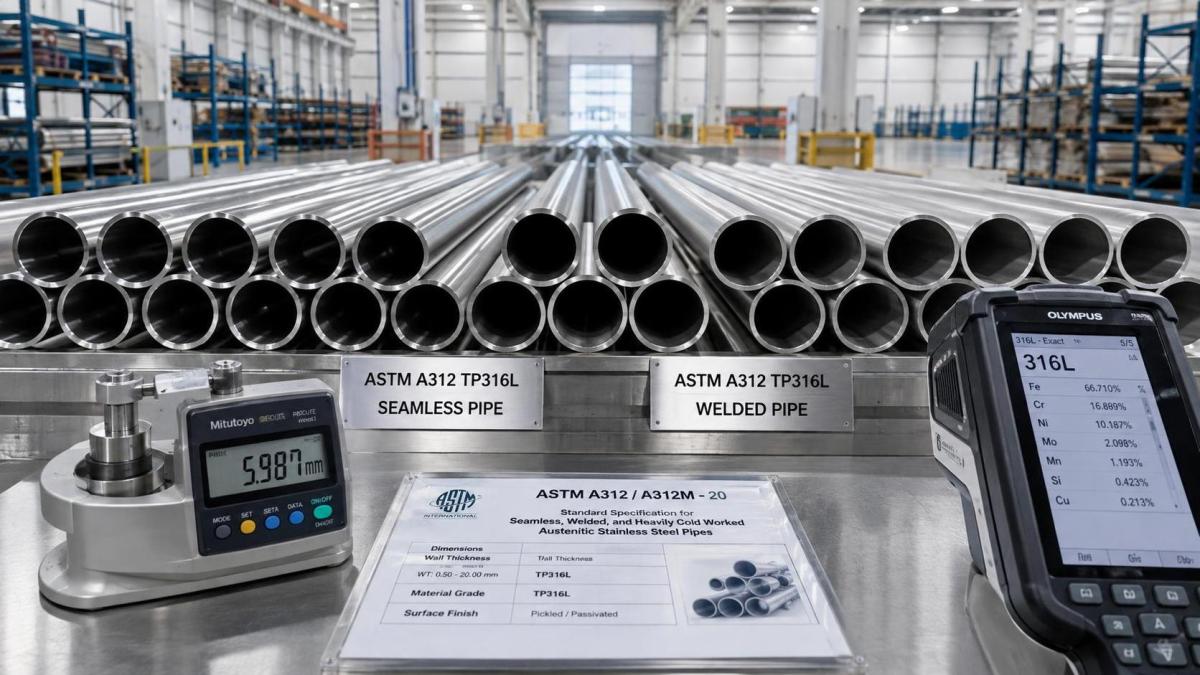
Also confirm whether the design calls for seamless pipe, welded pipe, or permits both. ASTM A312 covers each product type, but the project may limit their use by diameter, pressure class, cyclic loading, criticality, or local code. A specification that simply states “ASTM A312” without identifying seamless or welded construction leaves room for an unacceptable interpretation.
Dimensions and wall thickness are frequent cross-border problems
Overseas projects commonly mix inch-based and metric-based design information. ASTM A312 pipe may be ordered in NPS sizes and schedules, while drawings, valve connections, and site installation documents may use DN, metric outside diameters, or a separate dimensional standard. DN does not always provide a one-to-one dimensional substitute for NPS.
Before releasing an order, confirm the following items on the line list and material requisition:
- Nominal size and actual outside diameter;
- Wall thickness or schedule designation;
- Permitted thickness tolerance;
- Plain ends, beveled ends, threaded ends, or special preparation;
- Random length, cut length, or spool-related length limits;
- Ovality and straightness limits where automated welding or tight fit-up is involved;
- Compatibility with specified fittings, flanges, valves, and supports.
Schedule 10S, 40S, and other stainless pipe schedules are often associated with ASME B36.19M dimensions. However, the purchase specification should state the required dimensional basis directly rather than assuming every stakeholder applies the same schedule convention. A pipe that is chemically compliant but dimensionally incompatible can create costly field modifications.
Testing requirements need to be written into the purchase specification
ASTM A312 includes testing provisions, but the purchaser still needs to state which options apply to the project and how results must be documented. The required examination route can differ according to pipe type, size, wall thickness, code requirements, and project risk classification.
For welded stainless steel pipe, the technical review should identify whether weld seam treatment, weld repair restrictions, examination method, and heat treatment condition are acceptable. In certain services, the purchaser may require full traceability of welded pipe, additional nondestructive examination, or restrictions on specific manufacturing routes. These requirements should not be added informally after production has started.
Hydrostatic testing also deserves clear treatment. A project may require hydrostatic testing, may permit nondestructive electric testing under defined conditions, or may impose a separate system pressure test after fabrication. The material certificate, mill test records, and construction test package serve different purposes. Confusing them can create a documentation gap during handover.
Material traceability is often the decisive issue
ASTM A312 marking and test requirements help establish product identity, but overseas contracts frequently demand a more detailed documentation trail. The required level depends on the contract, inspection plan, end-user procedures, and applicable regulations. A buyer may require heat number traceability from each pipe length to the material test report, traceable cut pieces, inspection release records, or an inspection certificate format accepted by the project.
Do not assume that a document described as an “MTC,” “MTR,” or “3.1 certificate” contains the same information in every supply chain. Review the actual required content. At minimum, the documentation request should address the material grade, heat number, chemical analysis, mechanical test results, dimensional identification, applicable standard, manufacturing route where relevant, heat treatment status, and test or examination results required by the order.
Traceability must survive practical handling. Pipes may be cut, bundled, blasted, pickled, passivated, or transferred to a fabrication shop. If original markings disappear, the contractor needs a controlled method to preserve identification. This is particularly important where several stainless grades are present on the same site and mix-up prevention is part of the quality plan.
Local regulations and client specifications can add another approval layer
Where the pipe forms part of regulated pressure equipment, local legal requirements may govern conformity assessment, approved materials, notified inspection activities, marking, or documentation. ASTM A312 may still be acceptable, but only after the responsible design authority confirms its status within the applicable regulatory framework.
Client specifications can be stricter than both the ASTM standard and the local minimum. They may require positive material identification, ferrite limits for certain welds, corrosion testing, surface-finish criteria, restricted chemical composition, supplementary examination, or independent inspection. These additions are not evidence that ASTM A312 is inadequate; they reflect the fact that a general material standard cannot anticipate every service condition.
A useful approval question is not “Does the mill certify ASTM A312?” but “Does the proposed pipe meet every mandatory requirement in the material requisition, code, drawings, inspection plan, and destination-country rules?” That question prevents a standard certificate from being treated as a complete technical submittal.
A practical approval sequence before placing the order
- Read the line class and material requisition together. Identify grade, pipe type, size range, schedule, corrosion allowance if applicable, design temperature, design pressure, and intended fluid.
- Confirm the governing hierarchy. Establish whether the contract gives priority to project specifications, local regulations, piping code requirements, ASTM standards, or approved deviations.
- Check the exact standard edition and supplementary requirements. Avoid accepting a generic statement such as “ASTM A312 compliant” when the project identifies particular testing, dimensions, or documentation.
- Compare proposed material with local or client standards. Use a technical comparison covering composition, mechanical properties, delivery condition, dimensions, examinations, and certification—not a grade-name cross-reference alone.
- Define inspection records before manufacture. Confirm required certificates, marking, hold points, witness points, third-party inspection, and release documentation.
- Review samples of documentation where the package is critical. A sample certificate can reveal missing fields, unclear heat traceability, or inconsistent references before the shipment is produced.
When ASTM A312 is usually a workable basis
ASTM A312 is generally a practical basis when the project design documents explicitly specify it, the selected grade is suitable for the service environment, the pipe type and dimensions are fully defined, and the governing code accepts the material for the intended duty. It is also important that the ordered testing and documentation match the project inspection requirements.
It becomes insufficient when it is used as a shorthand for all material, design, legal, and quality obligations. This is most likely in projects involving pressure equipment regulation, mixed ASTM and EN interfaces, severe corrosion exposure, critical process services, special dimensional systems, or strict end-user documentation rules.
The safest procurement language identifies the complete requirement: ASTM A312 grade and product form, applicable dimensional standard, schedule or wall thickness, end condition, testing method, inspection documentation, traceability expectations, and any project or local-code additions. That approach gives the mill, inspector, fabricator, and technical reviewer the same basis for acceptance before material reaches the site.
Please give us a message
Tianjin Kaichuang Metal Material Co., Ltd
Add: No. 41, District 6, First Street, Huanghuadian Town, Wuqing District, Tianjin
Tel: + 86 137 9101 9833
E-mail: boss@kaichsteel.com