Steel Hub

How to Prevent Stainless Steel Pipe Contamination in Transit
Knowing how to avoid stainless steel pipe contamination during transport is essential for operators responsible for preserving surface quality, corrosion resistance, and customer compliance. A pipe may leave the mill clean, correctly identified, and suitable for a demanding service environment, yet arrive with embedded carbon steel particles, water stains, chlorides, abrasive damage, or mixed material markings. The damage is often discovered only after fabrication, pickling, passivation, or installation—when correcting it becomes slower and more expensive.
Transit contamination is not simply a packaging issue. It is a chain-of-custody issue involving dispatch, vehicle condition, loading equipment, dunnage, weather protection, load restraint, handling at transfer points, and receiving inspection. Stainless steel is widely selected because its chromium-rich passive surface offers good corrosion resistance. That surface can still be compromised by foreign iron, chloride-bearing residues, stagnant moisture, or damage that is not removed before service.
For pipe used in construction, equipment manufacturing, energy systems, shipbuilding, food-related process equipment, or rail applications, a clean delivery is part of the product’s usable condition. In the broader steel supply chain, where plate, sections, pipe, wire rod, and other rolled products move through several parties before final use, transport discipline also affects delivery reliability, rework risk, and downstream scheduling.
Understand What “Contamination” Looks Like in Practice
Not every mark on stainless steel pipe has the same cause or consequence. Operators should distinguish between cosmetic dirt and contaminants that can create corrosion concerns, fabrication problems, or material traceability failures.
- Free iron contamination: carbon steel dust, grinding particles, scale, wire fragments, or rust transferred from racks, forklifts, chains, and shared loading areas. These particles can rust on the stainless surface and may be mistaken for failure of the stainless material itself.
- Chloride contamination: exposure to salt spray, contaminated water, road de-icing residues, marine cargo environments, or unsuitable cleaning products. Chlorides deserve particular attention where stainless pipe will serve in a wet, warm, or chloride-bearing environment.
- Moisture entrapment: condensation beneath wrapping, rainwater trapped between pipes, wet timber, or water retained inside open pipe ends. Staining and localized corrosion risks increase when moisture remains in contact with a surface for extended periods.
- Organic and chemical residue: oil, grease, adhesive residue, paint transfer, dirty gloves, or residues from cargo previously carried in the vehicle. Such contamination can interfere with welding, coating, inspection, or cleaning operations.
- Physical cross-contamination: lost heat numbers, mixed grades, switched bundles, or damaged labels. A clean pipe that cannot be reliably identified may still be rejected by a controlled project.
A common mistake is to focus only on visible rust. By the time orange staining appears, foreign iron may already have been present for some time. Conversely, a pipe can look clean while carrying salt residue, adhesive traces, or moisture inside the bore. Good transport control therefore combines visual checks with sensible preventive barriers.
Start With a Clean Separation Plan Before Loading
The most reliable way to prevent contamination is to avoid creating the contact in the first place. Stainless steel pipe should not be treated as interchangeable with carbon steel pipe merely because both can be bundled and transported on the same truck or in the same warehouse.
Before a vehicle is loaded, inspect the bed, container floor, sidewalls, and restraint points. Loose scale, rust flakes, welding debris, sharp metal fragments, wet residues, and remnants of prior cargo should be removed. This is especially relevant for shared vehicles that routinely carry carbon steel sections, coils, fabricated frames, or scrap. A trailer can appear generally clean while still having abrasive debris concentrated around tie-down points and wheel arches.
Segregation should extend to all contact surfaces. Use clean, dry dunnage between the pipes and the vehicle floor. Timber can be practical when it is dry, reasonably smooth, free from protruding fasteners, and not contaminated by salts, oils, or rust. Non-metallic separators, protective saddles, and clean polymer pads may be preferable where surface finish requirements are stricter. The objective is not to use a particular material in every situation; it is to prevent metal-to-metal rubbing, trapped water, and transfer of foreign material.
If stainless and carbon steel must travel in the same load, create a real physical boundary rather than relying on the pipes being placed “a little apart.” Separate dunnage, protective sheeting, and controlled loading order reduce the chance that one bundle shifts into another during braking or vibration. Stainless pipe should never rest directly on rusty carbon steel supports, chains, mesh, or scrap pieces.
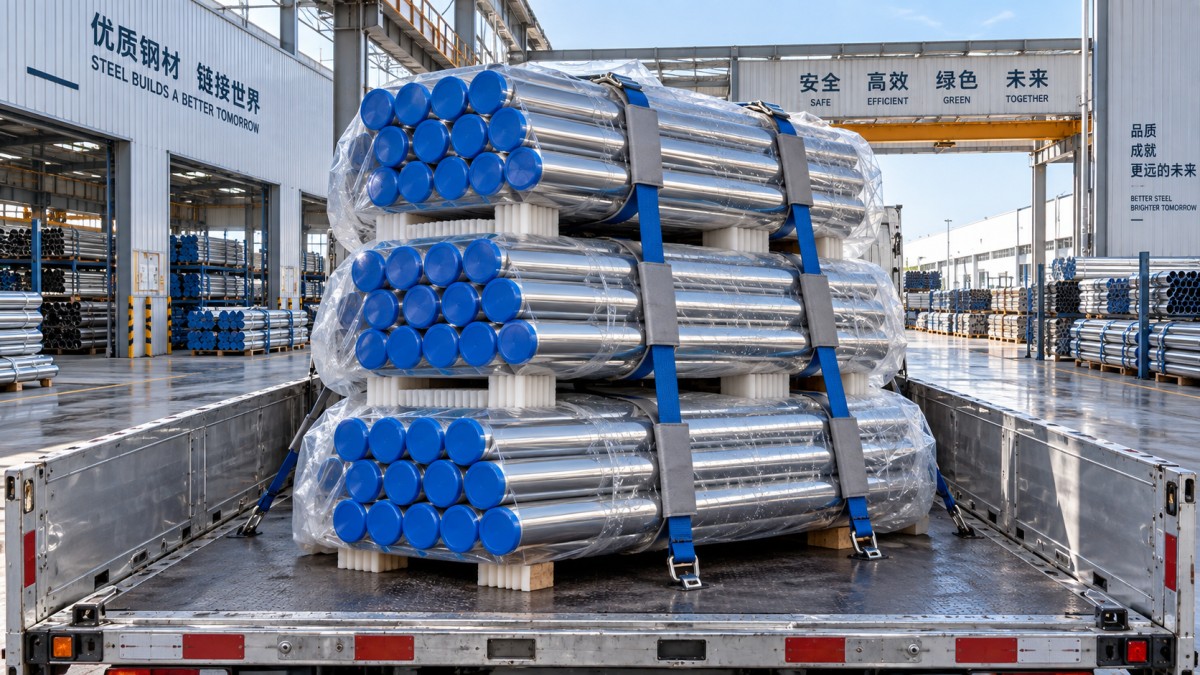
Packaging Must Protect Without Trapping Water
Packaging has two jobs that can conflict: it must keep dirt and rain away, while avoiding a sealed environment that retains condensation. The right balance depends on pipe finish, size, length, transport route, expected weather, storage time, and whether the load will pass through multiple terminals.
For many deliveries, bundles are protected with a combination of end caps, spacers, wrapping, edge protection, and external covers. End caps keep coarse dirt, insects, standing water, and handling debris out of the bore. They are particularly useful for pipe that will be installed in clean systems or prepared for welding. However, caps should be checked for fit and condition. A loose cap can trap water after rain, while a damaged cap may become a source of plastic debris inside the pipe.
Protective film and wrap should be intact but not blindly assumed to be waterproof forever. Tears often occur at sharp corners, sling contact points, and bundle edges. If pipe is wrapped while still wet, moisture can remain against the surface. When loading after rain or washing, allow the material and dunnage to dry where practical before closing it under a cover. This simple step is often more valuable than adding another layer of wrapping.
Avoid using packaging materials that can stain, abrade, or leave adhesive residue on the pipe. Reused protective materials may be economical, but they need inspection. A dirty cover that previously contacted rusted steel does not become suitable for stainless pipe simply because it is dry.
Secure the Load Without Damaging the Surface
Load restraint is where otherwise well-packaged pipe often gets damaged. Movement during transit can wear through wrapping, flatten bundle edges, break caps, and press contamination into the surface. The load must be restrained sufficiently for the route and transport mode, but the restraint system must also be compatible with the pipe finish.
Do not place bare chains, steel wires, or unprotected metal straps directly across stainless pipe. Where straps are necessary, use clean protective sleeves, corner guards, or suitable non-metallic contact protection. Inspect those sleeves as carefully as the straps: a worn sleeve can expose metal at precisely the point where vibration is highest. Keep tie-down hardware clear of pipe ends and avoid a configuration that lets the bundle slide under restraint.
Forklift handling requires the same care. Fork tines should be clean and free from loose rust, grease, or sharp burrs. Bare forks can scratch individual pipes and transfer debris from earlier carbon steel handling. For larger bundles, use appropriate lifting points and stable support rather than repeatedly repositioning the load. Dragging pipe, rolling it across a dirty floor, or using a steel crowbar to adjust a bundle can undo all the effort spent on packaging.
Weather, Route, and Storage Change the Risk
A short covered delivery from a local stockyard is not managed in the same way as a multi-leg shipment involving road, port storage, sea freight, and inland transfer. The longer the material is exposed to handling changes and variable weather, the more important packaging integrity and inspection become.
Marine and coastal routes require additional caution because airborne salt and saltwater exposure can enter through damaged wrapping or open ends. On road transport, wet roads and de-icing materials can contaminate lower portions of an uncovered load. In humid climates, condensation may form inside a cover even when no rain reaches the pipe. Operators should think in terms of exposure conditions, not simply whether the shipment is classified as indoor or outdoor transport.
Temporary storage during transit is another weak point. Pipes should be kept off bare ground, away from standing water, and protected from runoff from carbon steel storage areas. Storing stainless bundles beneath a leaking roof or beside a grinding operation can be as damaging as poor vehicle loading. If a shipment is held longer than planned, inspect the cover and supports again rather than assuming the original dispatch condition remains unchanged.
Protect Traceability Along With Surface Quality
Contamination control and traceability are closely connected. During handling, tags can tear off, ink markings can be rubbed away, and bundles may be divided for easier unloading. Once this happens, material grade, size, heat-related documentation, and customer order details can become uncertain. The result may be a hold on fabrication even if the pipe itself remains undamaged.
Use durable bundle identification that remains visible after wrapping and that corresponds to packing records. Where internal markings are required, ensure the marking method is suitable for the project and does not create avoidable cleaning issues. At every transfer point, confirm that the physical bundle, label, quantity, and documentation still match. This is particularly important when different stainless grades or dimensions are shipped together.
Receiving teams should inspect before unloading is fully completed, while the transport condition can still be documented. Check the cover, end protection, bundle restraints, visible staining, water ingress, and labels. If there is a concern, photograph the condition, isolate the affected material, and avoid aggressive cleaning before the issue is assessed. Premature grinding or brushing may obscure evidence and can introduce further contamination if the wrong tools are used.
When Contamination Is Found, Do Not Treat Every Mark the Same
A light dust deposit may be removable through an appropriate cleaning process, while deep abrasion, embedded ferrous particles, chloride exposure, or unidentified chemical staining may require a more careful review. The correct response depends on the pipe grade, surface finish, intended service, project specification, and the nature of the contamination.
Avoid using ordinary carbon steel wire brushes, contaminated abrasives, or unknown cleaners on stainless pipe. These can transfer iron or damage the finish while appearing to solve the immediate problem. Dedicated stainless-compatible tools and cleaning materials are a sensible operating rule. For critical applications, the cleaning and restoration method should be agreed with the responsible quality team or the applicable project requirements rather than decided informally at the unloading bay.
The practical answer to how to avoid stainless steel pipe contamination during transport is not a single packaging material or a final inspection form. It is a controlled sequence: clean vehicle, separated supports, dry and suitable packaging, protected restraints, careful handling, weather-aware storage, and documented receiving checks. When these controls are routine, stainless pipe reaches fabrication or installation in the condition its specification assumes—and operators spend less time explaining preventable stains, scratches, and missing identification.
Please give us a message
Tianjin Kaichuang Metal Material Co., Ltd
Add: No. 41, District 6, First Street, Huanghuadian Town, Wuqing District, Tianjin
Tel: + 86 137 9101 9833
E-mail: boss@kaichsteel.com