Steel Hub

Welded Pipe Price Factors That Affect Total Project Cost
When you are building a project budget, a welded pipe quote is rarely just a material number. The per-ton or per-meter price may look straightforward, but the real cost moves once you define grade, wall thickness, end finish, testing, packing, shipping, delivery timing, and the consequences of getting any of those wrong. For business assessment professionals, that is where the real evaluation work starts.
If you are comparing suppliers or checking whether a bid is commercially realistic, use the list below the way experienced procurement teams do: not as a generic checklist, but as a way to find what is missing from the quote before it becomes a cost overrun.
Start with the base material, not the headline price
A low welded pipe price can be misleading if the steel grade behind it is not clearly stated. In practice, raw material cost is one of the biggest drivers because hot rolled coil, strip, or plate pricing feeds directly into the finished pipe cost. If the supplier quote only says “carbon steel welded pipe” without grade, standard, or chemical/mechanical requirements, you do not yet have a usable number.
Check whether the offer is tied to a specific standard such as ASTM, EN, API, JIS, or GB, and whether equivalent substitution is allowed. In many projects, “equivalent” becomes a problem later because inspection, certification, or end-user approval does not accept the replacement. That can force re-procurement or additional testing, both of which cost more than the initial price difference.
- Ask what raw material form is used: coil, strip, or plate.
- Confirm the steel grade and manufacturing standard in writing.
- Check whether mill test certificates are included or charged separately.
- If the project needs traceability, ask how heat numbers are maintained through production.
This sounds basic, but many budget reviews fail here. People compare two prices that are not actually for the same pipe.
Specifications change cost faster than buyers expect
Diameter and wall thickness do more than change weight. They can shift production route, yield loss, welding difficulty, inspection scope, and transport efficiency. Thin-wall pipe may require tighter process control. Heavy-wall pipe usually means more steel input and can narrow the pool of capable suppliers. Larger diameters may also move freight from standard loading to special handling.
Length matters too. Buyers often focus on tonnage, but random length versus fixed length can materially change the offer. Cut-to-length requirements, tighter tolerance, beveling, threading, grooving, or coupling supply all add processing cost. None of these are unusual, but they should be visible in the commercial comparison sheet.
If one supplier includes these details and another leaves them open, the cheaper quote is often only incomplete.
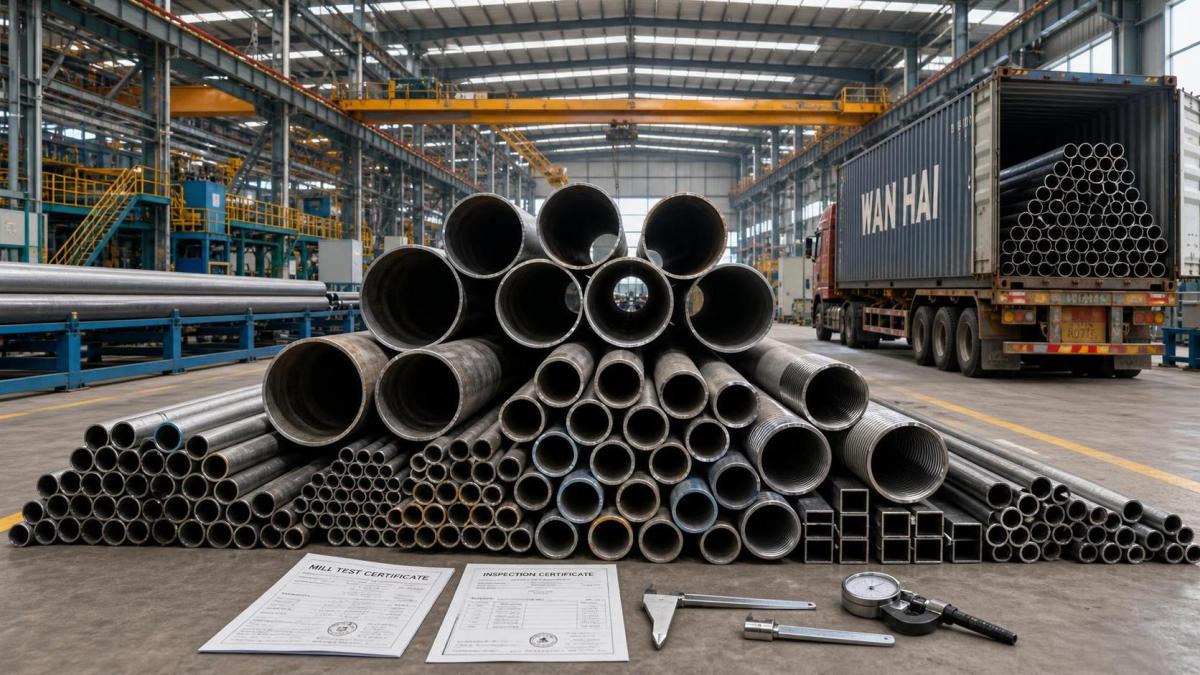
Do not separate manufacturing method from price review
In welded pipe procurement, the production route influences both cost and suitability. ERW, LSAW, and SSAW pipes do not sit in the same cost structure, and they are not interchangeable just because they are all welded products. If your internal estimate mixes them loosely, the budget can be wrong from the beginning.
The same applies to post-processing. Galvanizing, external coating, internal lining, hydrostatic testing, non-destructive testing, third-party inspection, or special marking requirements can move the total project cost well beyond the base pipe price. These items are often treated as add-ons, but from a commercial risk perspective they should be part of the first comparison round.
A useful check in RFQ review: if the line item simply says welded pipe but the downstream application is fire protection, structural use, piling, water transmission, or line pipe service, go back and verify the required processing and inspection scope. Application assumptions create expensive mistakes.
Small orders are usually expensive in ways the quote does not spell out
Order volume affects unit cost in a very practical way. Mills and pipe processors optimize around production runs, coil usage, setup time, and packaging efficiency. A small mixed-size order can carry hidden cost through minimum rolling quantities, changeover loss, or surcharge for non-standard production.
This matters in project procurement because budget owners may assume that splitting orders among several suppliers reduces risk. Sometimes it does. But for welded pipe, fragmentation can also increase cost, create inconsistent documentation, and complicate inspection. If the specification is standardized and the supplier is capable, order consolidation often gives you a cleaner landed cost and fewer coordination failures.
Ask these questions early:
- Is the quoted price based on MOQ?
- Are mixed sizes bundled into one commercial offer with surcharges hidden in the average rate?
- Will over-rolling or under-delivery tolerance affect payable quantity?
- Does the supplier reserve the right to ship quantity variance under the contract terms?
Those last two points are worth attention. A price can look fine until the final invoiced tonnage exceeds the budget allowance.
Freight, packing, and delivery terms often decide the real winner
A welded pipe quote should never be reviewed without Incoterms, packing assumptions, loading method, and destination constraints. For long products, especially pipe, logistics can distort the comparison more than buyers expect. Two suppliers may be close on ex-works pricing, but the delivered project cost changes once you account for inland haulage, port charges, container versus breakbulk suitability, export packing, and discharge conditions.
For international purchases, also check whether the proposed packing matches the route and storage conditions. Bundling, end caps, waterproof wrapping, wooden supports, and marking are not cosmetic. Damage in transit, corrosion during storage, or identity loss on site can all become real commercial losses.
If your evaluation model still compares supplier A on FOB and supplier B on delivered basis without normalizing the cost, fix that first. It is one of the most common reasons a sourcing report looks convincing but fails in execution.
Lead time has a cost, even when it is not visible on the quote sheet
In steel procurement, schedule pressure usually shows up as a price issue later. If the project needs a short delivery window, the supplier may use higher-cost raw material allocation, run overtime, subcontract processing, or ship partial lots by more expensive routes. Even when the quoted unit rate stays unchanged, the total procurement cost can rise through expediting fees, split shipments, site handling, or delay penalties elsewhere in the project.
Business assessment teams should treat delivery commitment as part of price credibility. A supplier offering the lowest welded pipe price with a weak or vague schedule is not necessarily cheaper. Review production capacity, stock availability, and whether the quote is for made-to-order or from inventory. For commodity sizes, stock can reduce timing risk. For special dimensions or coatings, “fast delivery” should be verified carefully.
If the supplier says delivery depends on raw material market availability, that is not unusual. It does mean your estimate should include contingency.
Testing, documentation, and compliance are not side notes
For many projects, documentation cost is small compared with material cost, but the risk of missing documentation is large. Mill test certificates, inspection reports, coating records, dimensional reports, and third-party witness requirements can delay acceptance or payment. In some markets and project types, compliance with specified standards is a hard gate rather than a negotiable point.
Do not assume all quotes include the same level of testing. Some suppliers price only routine mill inspection. Others include hydrotest, NDT, or third-party coordination only after order confirmation. Where the project references a standard or owner specification, confirm exactly what is included and what is extra. If there are country-specific import or project approval requirements, verify those against current regulations and contract documents because requirements vary and may change【待核实】.
Market timing can move price more than negotiations do
Steel prices are exposed to raw material swings, energy costs, capacity changes, regional demand, trade measures, and freight volatility. No checklist can predict all of that, but good procurement review separates fixed-price confidence from price exposure. If the quote validity is short, or if it is tied to future raw material adjustment, your internal approval should not treat it as a stable budget number.
This is where many business cases become too optimistic. The team uses today’s welded pipe quote for a project that will purchase three months later, then acts surprised when the market has moved. If the procurement schedule is not immediate, ask for the pricing basis, validity period, and escalation mechanism. A slightly higher fixed offer may be commercially safer than a lower floating one.
A practical review pass before you approve the budget
- Make sure all supplier comparisons use the same grade, standard, size range, and finish.
- Normalize freight and commercial terms before ranking suppliers.
- Separate base pipe price from testing, coating, packing, and documentation charges.
- Check quantity tolerance, MOQ, and any surcharge for mixed sizes or small lots.
- Review delivery realism, not just the promised date.
- Confirm whether taxes, duties, and destination charges are included in your cost model.
- Leave room for market movement if the quote validity does not cover the procurement window.
That last pass is usually enough to expose whether a low quote is actually competitive or just incomplete. In welded pipe sourcing, the best pricing decision is rarely the cheapest line on the sheet. It is the offer that stays commercially true after specification, compliance, delivery, and logistics are all brought into the same number.
Please give us a message
Tianjin Kaichuang Metal Material Co., Ltd
Add: No. 41, District 6, First Street, Huanghuadian Town, Wuqing District, Tianjin
Tel: + 86 137 9101 9833
E-mail: boss@kaichsteel.com