Steel Hub

Steel structure delivery delays on large sites rarely come from one isolated mistake. They usually develop where several handoffs meet: design release, material purchasing, shop fabrication, inspection, transport, and site receiving. A truck arriving late is often only the visible symptom. The original cause may be an unfinished connection detail, a missing approval, an overloaded fabrication line, or a site that cannot safely unload the load that has already been made.
The practical response is not simply to demand a faster delivery date. It is to identify which stage controls the critical path, then manage the interfaces around that stage. Steel sections, plates, tubes, and connection components move through a supply chain that begins with mill availability and ends with erection sequencing. A schedule is reliable only when those links are aligned.
Design information released too late or changed too often
Fabrication cannot proceed properly from partially developed drawings. A fabricator may be able to reserve steel, prepare a preliminary cutting list, or start work on unaffected members, but cutting, drilling, welding, coating, and marking all depend on released-for-fabrication information.
Late design changes are especially disruptive when they affect interfaces rather than a single isolated beam. A revised column location can change beam lengths, connection plates, bolt patterns, bracing details, deck supports, and adjacent trades. Even a seemingly minor change to a connection can require new drawings, material reassignment, rework, and another inspection cycle.
A common scheduling mistake is treating “design substantially complete” as equivalent to “fabrication-ready.” They are different milestones. For delivery control, the important question is: which packages are fully approved, frozen enough to fabricate, and linked to the erection sequence?
Break the structure into release packages that match installation priorities, such as foundations and anchor interfaces, primary frame, secondary steel, roof steel, stairs, platforms, or transfer structures. Each package should have a clear drawing status, decision owner, and latest acceptable release date.
Material availability is more than a steel purchasing issue
Steel fabrication depends on the availability of the correct grade, section size, plate thickness, and quantity at the right time. The steel industry supplies construction through mills, stockholders, processors, and fabricators, while also serving automotive, equipment, shipbuilding, energy, and other demand cycles. That broad demand base can affect lead times for particular products even when general steel supply appears adequate.
Not every steel item carries the same procurement risk. Common rolled sections may be sourced through established stock channels, while heavy sections, unusual plate dimensions, special grades, hollow sections, or project-specific connection materials can require longer coordination. Substitution is not a simple purchasing decision: it may affect structural design, connection design, welding procedures, coating compatibility, weight, and approval requirements.
Material risk becomes more serious when the project team waits for final drawings before checking supply. Early procurement review should identify members or materials with limited availability, confirm whether the fabricator will use mill orders or stock material, and establish what substitutions are technically acceptable before a shortage becomes urgent.
Why “material on order” is not enough
A purchase order does not mean material is available for fabrication. The useful status is more specific: material allocated, received, inspected, traceable, and released to the shop for the relevant package. A project can report that steel is ordered while the fabrication line remains unable to start because the required plate or section has not arrived, has failed incoming checks, or belongs to a different package.
Material traceability also matters. If markings, certificates, or identification are not maintained through cutting and assembly, a finished member may be held before shipment while documentation is reconstructed. This is often avoidable through a clear material-control process agreed before production begins.
Fabrication capacity and sequencing create hidden bottlenecks
Fabrication duration is not just cutting and welding time. It includes detailing review, nesting, material handling, fit-up, welding, straightening where required, inspection, repair work, surface preparation, coating, curing, marking, packing, and load planning. A shop may have enough total capacity but still lack capacity at one constrained operation.
Complex welded assemblies, dense connection zones, heavy plate work, circular hollow sections, and members with many attachments generally require more coordination than straightforward rolled beams. The issue is not that these elements are inherently problematic; it is that their actual shop sequence must be reflected in the delivery plan.
Another frequent cause of delay is fabrication in the wrong order. Producing the easiest members first can make shop progress look healthy while holding back the few columns, transfer girders, or braced frames that control erection. Progress should therefore be measured against the site’s installation sequence, not only by tonnage completed.
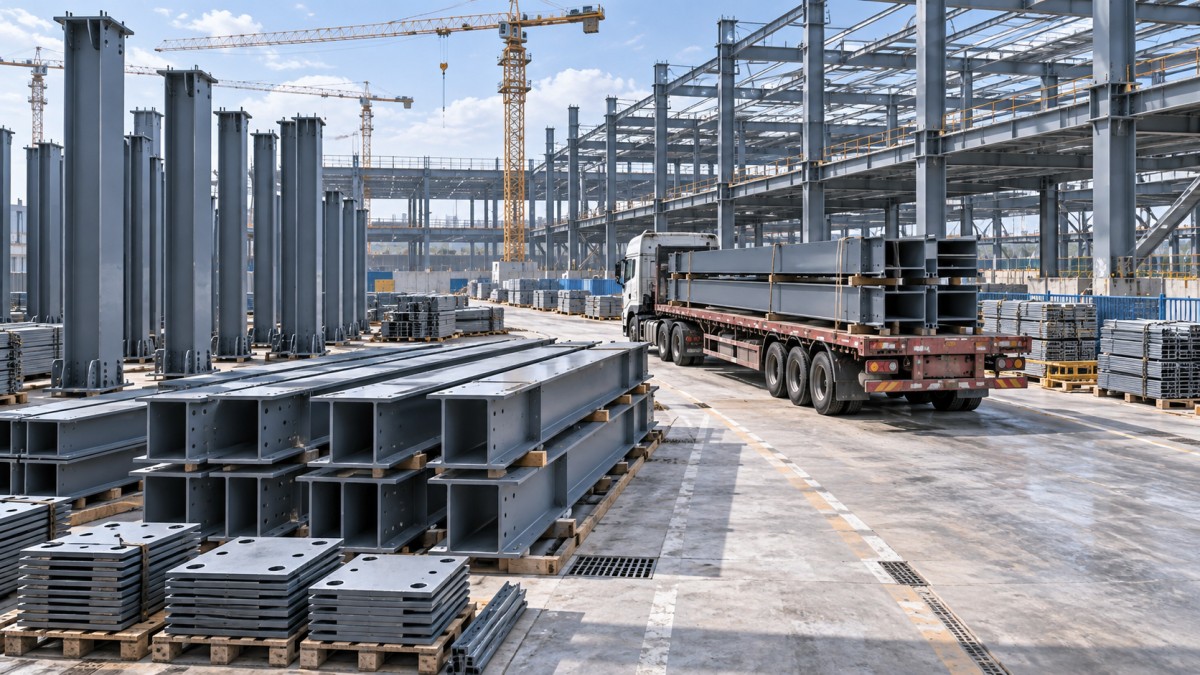
Ask the fabricator for a package-level production schedule tied to erection zones. It should show drawing release, material arrival, fabrication start, inspection hold points, coating completion, and planned dispatch. This makes it possible to see whether a delivery risk begins in engineering, procurement, fabrication, or final logistics.
Inspection, coating, and documentation are often underestimated
Members can be physically complete but not ready to ship. Inspection holds may arise from weld examination, dimensional checks, connection fit-up, coating preparation, paint repairs, or incomplete quality records. These activities need time and access; they cannot always be compressed without creating congestion or compromising the planned workflow.
Coated steel adds another dependency. Surface preparation, application conditions, curing, handling protection, and repair after damage all affect dispatch readiness. If coating is scheduled at the end of fabrication without sufficient allowance, completed steel can accumulate in the yard waiting for release.
The project team should agree which documents are needed before shipment, which can follow with the delivery package, and who reviews them. Requiring every document to be closed before any load moves may delay urgent erection steel unnecessarily. Releasing material without the records needed for site acceptance creates a different problem. The correct approach depends on the project’s quality plan and contractual requirements, but the release sequence should be explicit.
Transport planning fails when it begins after fabrication
Large-site deliveries are constrained by more than vehicle availability. Long or heavy members may require special routing, suitable trailers, lifting arrangements, delivery windows, and access routes that can handle the vehicle and load. A fabricated steel frame may be ready at the shop but still wait because the planned transport cannot legally or practically make the journey at the required time.
Load configuration matters as much as delivery date. Steel should be loaded in a sequence that supports unloading and erection. If the first member required is buried beneath later-stage steel, site crews may need to reshuffle loads, consume crane time, create damage risk, or reject the load. Sending steel “as soon as it is ready” can be less useful than sending a smaller, correctly sequenced erection package.
The site can cause the delay even when steel is ready
On a large project, the receiving operation is part of the steel delivery system. Limited gate access, shared haul roads, restricted delivery hours, incomplete access roads, wet or congested laydown areas, crane conflicts, and unavailable unloading crews can all stop delivery.
Site constraints become more severe when several contractors use the same logistics plan. Concrete works, facade installation, mechanical equipment deliveries, and steel erection may compete for the same roads, cranes, staging areas, and time slots. A delivery booking system helps only when the site can actually receive and unload the booked vehicle.
Before dispatch, confirm the practical conditions: gate and route availability, vehicle size restrictions, laydown location, unloading equipment, responsible receiver, weather-sensitive ground conditions, and the members needed next. This check should be performed for each delivery zone, not assumed from a single early logistics review.
How to regain control when a delay is already developing
When dates begin to slip, avoid relying on broad status labels such as “fabrication delayed” or “supplier issue.” Separate the problem into individual members or packages and identify the earliest blocked activity. A delayed shop drawing, unavailable section, weld repair, coating queue, missing transport slot, and closed site gate need different corrective actions.
- Identify erection-critical steel. Focus on the members that prevent the next stable stage of installation, not the largest remaining tonnage.
- Map each critical item to a real status. Confirm drawing approval, material receipt, fabrication completion, inspection release, coating status, packing, transport booking, and site acceptance.
- Choose a recovery action that matches the cause. Expedite an approval when engineering is blocking work; resequence fabrication when the wrong package is being produced; split loads when transport or site access is limiting; revise the erection sequence only after checking structural stability and trade impacts.
- Protect the revised plan from further change. Repeated late requests for added brackets, revised holes, or altered member marks can erase the benefit of expediting.
- Run short coordination meetings around exceptions. The purpose is to resolve named constraints and ownership, not to repeat general progress reports.
Expediting is useful only when there is a clear constraint to remove. Pressuring every party at once may shift congestion from the shop to inspection, transport, or the site. A targeted recovery plan is more likely to protect the erection sequence and reduce idle labor.
Build delivery reliability into the procurement plan
The strongest prevention measure is to treat structural steel as a linked engineering, fabrication, and site-logistics package from the start. Procurement should not be measured only by contract award or material order placement. It should include drawing-release discipline, material-risk review, fabrication capacity, quality-release timing, transport planning, and receiving readiness.
For large sites, a useful control document is a rolling look-ahead schedule that connects installation zones with individual steel packages. It should show what must arrive, when it must be released from the shop, which decisions remain open, and what site condition is required to receive it. Update it when design, access, or erection sequencing changes.
The most damaging assumption is that steel delivery is a single supplier commitment. It is a chain of dependent commitments. When project controls expose those dependencies early, teams can protect critical steel packages, make informed resequencing decisions, and prevent a manageable issue from becoming an erection shutdown.
Please give us a message
Tianjin Kaichuang Metal Material Co., Ltd
Add: No. 41, District 6, First Street, Huanghuadian Town, Wuqing District, Tianjin
Tel: + 86 137 9101 9833
E-mail: boss@kaichsteel.com