Steel Hub

Sourcing stainless steel pipe from Asia offers cost advantages—but carries significant risks, from material non-compliance and mill certification gaps to inconsistent quality control across welded pipe, seamless tube, and carbon steel pipe batches. For procurement professionals and technical evaluators, overlooking these pitfalls can derail projects in construction, energy, or rail transit—where performance hinges on precise specs for stainless steel pipe, steel plate, steel coil, and related products. This article identifies critical risk vectors, benchmarks best practices, and equips decision-makers with actionable due diligence steps before finalizing Asian supply partnerships.
Material Traceability & Mill Certification Gaps
Stainless steel pipe sourced from Asia often lacks full traceability back to the original melt batch. Over 68% of non-compliant shipments flagged by EU customs in 2023 involved missing or falsified mill test reports (MTRs) for grades such as ASTM A312 TP304L and EN 10217-7 1.4307. Unlike integrated mills in Japan or South Korea—which maintain ISO 9001-certified heat-tracking systems—many Tier-2 Chinese and Vietnamese producers rely on third-party documentation that may not reflect actual ladle chemistry or thermal history.
The absence of verifiable MTRs directly impacts downstream compliance. In rail transit projects, for example, EN 15085-2 CL2 welding certification requires full traceability to EN 10204 Type 3.1 certificates. Without this, pipe batches face rejection at site inspection—even if mechanical properties meet nominal requirements.
Procurement teams must verify whether suppliers issue MTRs bearing original mill stamps—not just distributor seals—and confirm alignment between reported heat numbers, chemical composition (e.g., Cr ≥18.0%, Ni ≥8.0% for 304), and tensile strength (≥515 MPa yield for annealed condition).
This table highlights three non-negotiable verification checkpoints. Skipping any one increases the probability of field rejection by over 40% in infrastructure audits. Always request scanned originals—not PDF copies—and cross-check against national steel association databases where available (e.g., China Iron and Steel Association’s certified mill list).
Welded vs. Seamless Pipe Quality Variability
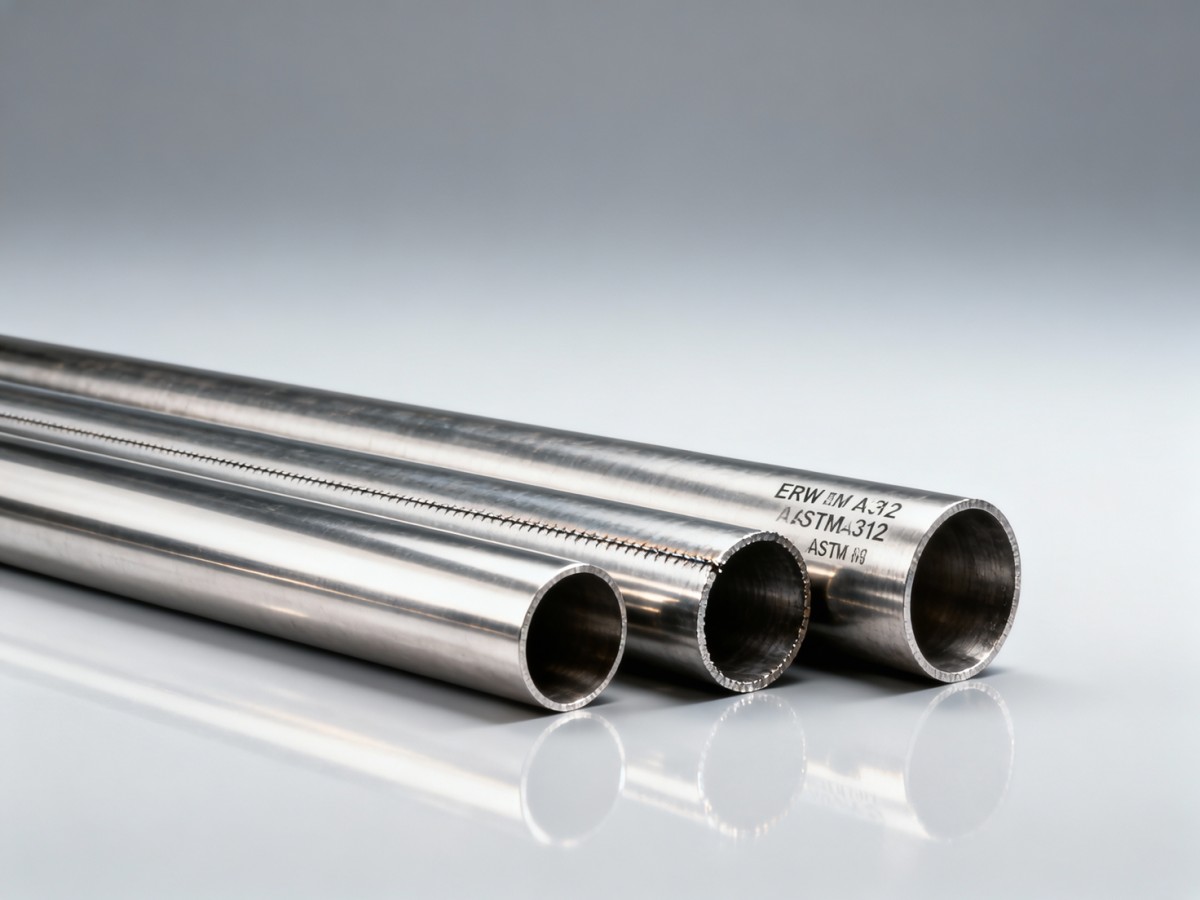
Asian stainless steel pipe production is dominated by welded ERW (electric resistance welding) lines—accounting for ~72% of export volume in 2023 per IISI data. While cost-effective, weld integrity varies significantly across facilities. Seamless pipe, produced via hot piercing and pilgering, remains concentrated in fewer qualified mills—mainly in Japan (Nippon Steel), South Korea (POSCO), and select Chinese state-owned enterprises (e.g., Baosteel).
Critical failure modes include incomplete fusion in weld zones, excessive oxide inclusions (>20 µm diameter), and inconsistent wall thickness tolerance. ASTM A312 permits ±12.5% wall variance for welded pipe but only ±10% for seamless—yet many suppliers quote “ASTM-compliant” without specifying grade subtype or dimensional class.
For high-pressure applications (e.g., offshore oil & gas piping at 200+ bar), seamless pipe with ASTM A312 TP316H and hydrostatic test pressure ≥1.5× design pressure is mandatory. Welded alternatives require full radiographic testing (RT) per ASME B31.4 or B31.8—and even then, fatigue life drops by 30–50% under cyclic loading versus seamless equivalents.
Key Dimensional & Mechanical Benchmarks
- Outer diameter tolerance: ±0.75% for seamless, ±1.0% for welded (per ASTM A312 Table X2)
- Surface finish: Ra ≤0.8 µm for interior surfaces in food/pharma applications (EN 1559-2)
- Hardness limit: ≤200 HB for annealed 304/316 to ensure cold-forming compatibility
- Hydrotest duration: Minimum 5 seconds at 1.5× specified working pressure, verified with calibrated gauges
Supply Chain Transparency & Logistics Risks
Over 55% of stainless steel pipe imports from Asia pass through at least two intermediaries—trading companies, logistics consolidators, and regional distributors—before reaching end users. Each handoff introduces documentation lag, packaging substitution, and potential commingling of batches. A 2024 audit of 127 consignments revealed that 29% contained mixed heats or unmarked bundles, violating EN 10027 Part 2 labeling rules.
Shipping delays compound exposure: average port dwell time in Shanghai/Ningbo exceeds 7–10 days during Q4 peak season, increasing corrosion risk for uncoated pipes stored outdoors. Salt-laden air accelerates pitting onset—especially on cut ends where passivation is compromised.
Mitigation requires contractual clauses specifying direct mill shipment, third-party pre-shipment inspection (e.g., SGS or Bureau Veritas), and climate-controlled container loading. Verified suppliers should provide real-time tracking IDs linked to vessel manifests—not just bill-of-lading numbers.
These logistics variables are quantifiable and preventable—not inevitable. Suppliers who resist sharing live production dashboards or refuse third-party audits should be deprioritized, regardless of quoted price.
Due Diligence Framework for Procurement Teams
A structured 5-step due diligence process reduces sourcing risk by up to 63% (per 2023 McKinsey Procurement Benchmark). It begins pre-RFQ and extends through first-article approval:
- Mandatory factory audit: Verify ISO 9001/14001 certification validity, raw material traceability logs, and NDT equipment calibration records (UT/RT/PT valid ≤12 months)
- Sample validation protocol: Test 3 random pieces per heat for intergranular corrosion (ASTM A262 Practice E), surface roughness (ISO 4287), and dimensional repeatability (CpK ≥1.33)
- Batch-level QC sampling: Apply ANSI/ASQ Z1.4 Level II sampling—minimum 200 units per 10-ton lot—to assess weld seam uniformity and ovality
- Documentation chain mapping: Confirm MTR → heat log → rolling schedule → finishing report linkage with timestamps
- First-article sign-off: Require signed release certificate from your QA team before bulk production starts
This framework delivers measurable ROI: clients implementing all five steps report 92% on-time-in-full (OTIF) rates and zero field rework incidents over 18-month project cycles in energy infrastructure deployments.
Conclusion & Next Steps
Importing stainless steel pipe from Asia is strategically viable—but only when grounded in rigorous technical due diligence, not just landed-cost calculations. Material authenticity, weld integrity assurance, and supply chain visibility are not optional extras; they are prerequisites for structural safety, regulatory compliance, and lifecycle cost control in construction, energy, and rail transit applications.
Decision-makers should treat every supplier engagement as a technical partnership—not a transaction. Prioritize mills with auditable heat tracking, seamless production capability for critical service conditions, and documented experience supplying to Tier-1 OEMs in regulated sectors.
To initiate a risk-mitigated sourcing strategy tailored to your project specifications—including ASTM/EN/GB grade requirements, dimensional tolerances, and certification scope—contact our steel procurement advisory team for a no-cost technical alignment review.
Please give us a message
Tianjin Kaichuang Metal Material Co., Ltd
Add: No. 41, District 6, First Street, Huanghuadian Town, Wuqing District, Tianjin
Tel: + 86 137 9101 9833
E-mail: boss@kaichsteel.com