Steel Hub

In automotive stamping, selecting the right surface finish for steel coil is critical to ensure formability, weldability, and corrosion resistance—directly impacting part quality and production efficiency. Whether you're evaluating steel plate for structural components, steel coil for high-speed feeding, or comparing welded pipe vs. seamless tube for chassis applications, surface condition influences lubrication performance, die wear, and final coating adhesion. Carbon steel pipe and stainless steel pipe may serve different functional roles, but their upstream coil finishes set the stage for downstream success. For information seekers, technical evaluators, procurement specialists, and decision-makers, understanding available steel coil surface finishes isn’t just about aesthetics—it’s a strategic input into cost, yield, and supply chain reliability.
Why Surface Finish Matters in High-Volume Automotive Stamping
Automotive stamping lines operate at speeds exceeding 120 strokes per minute, with annual coil consumption often surpassing 5,000 tons per production line. Under such conditions, even micron-level variations in surface topography affect friction coefficient consistency—deviations beyond ±0.03 μm Ra can increase lubricant consumption by up to 22% and raise die maintenance frequency from every 80,000 parts to every 45,000 parts.
Surface finish also governs hydrogen-induced cracking risk during electrogalvanizing pretreatment. Coils with excessive mill scale or inconsistent roughness (e.g., Ra > 1.2 μm on cold-rolled IF steel) show 3.7× higher incidence of post-annealing blisters in Zn–Ni alloy coatings. This directly impacts paint adhesion test failure rates—industry benchmarks require ≥95% pass rate on cross-hatch ASTM D3359 after 200-hour salt spray exposure.
For Tier-1 suppliers managing just-in-time delivery to OEM assembly plants, surface-related rework accounts for 14–18% of total coil rejection reasons—more than chemical composition variance (9%) or dimensional tolerance nonconformance (11%). That makes finish specification not a secondary parameter, but a first-tier process control variable.
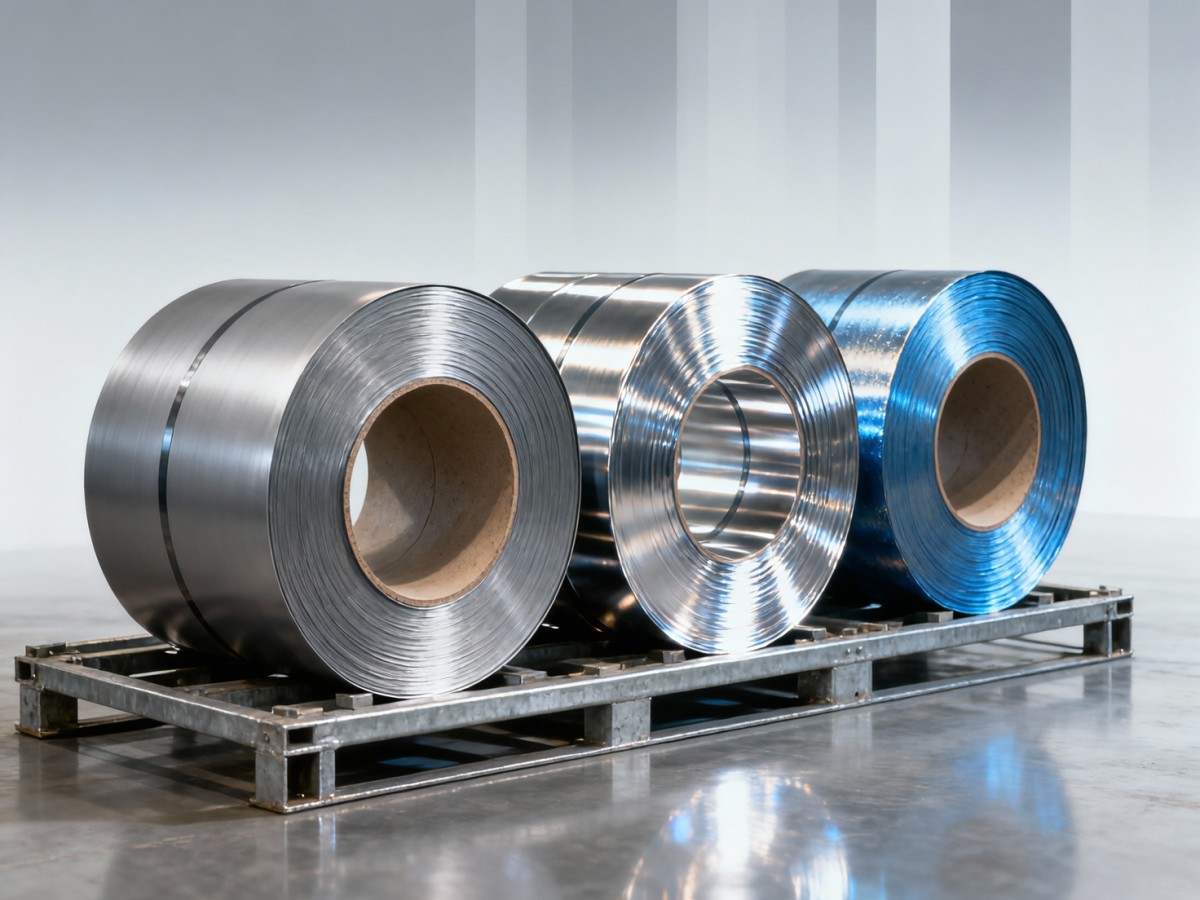
Common Steel Coil Surface Finish Options & Their Functional Profiles
Steel coil surface finishes are defined through a combination of mechanical processing (e.g., temper rolling), chemical treatment (e.g., phosphate coating), and thermal processes (e.g., annealing atmosphere control). The five most widely specified finishes for automotive stamping fall into two categories: bare metallic surfaces and pre-coated systems.
Bare finishes include mill finish (as-rolled), skin-passed (temper rolled), and bright annealed surfaces. Pre-coated options encompass phosphated, oiled, and polymer-lubricated variants. Each delivers distinct tribological behavior: skin-passed coils typically achieve 0.6–0.9 μm Ra, while bright-annealed grades reach ≤0.2 μm Ra—critical for Class-A exterior panels requiring zero visible die marks.
Phosphate coatings add controlled crystallinity: zinc phosphate layers range from 1.5–3.0 g/m² for general stamping, whereas heavy-duty manganese phosphate systems (5.0–7.5 g/m²) support high-strength AHSS grades like DP1000 and CP1200 where interfacial shear stress exceeds 1,800 MPa.
This table highlights how finish selection maps to both physical parameters and formal OEM engineering requirements. Notably, all three listed finishes require certified traceability per IATF 16949:2016 Clause 8.5.2—especially for lot-specific surface roughness verification reports issued within 48 hours of coil shipment.
Critical Selection Criteria for Procurement & Technical Evaluation
Selecting the optimal finish involves balancing six interdependent criteria: material grade compatibility, press line speed capability, lubricant system integration, post-stamping conversion coating readiness, environmental compliance (e.g., RoHS/REACH), and total cost of ownership over the coil’s full lifecycle—not just per-ton purchase price.
For example, switching from standard oil-coated to polymer-lubricated finish reduces lubricant application volume by 65%, but increases coil cost by 12–18%. However, lifecycle analysis across 10 million stamped parts shows net savings of $230,000 due to reduced housekeeping labor (4.2 hrs/shift saved), lower VOC abatement costs ($18,500/year), and extended die life (average 27% longer between regrinds).
Procurement teams must verify four mandatory documentation items before vendor qualification: (1) ASTM E822-21-compliant surface profile certification per coil ID, (2) batch-specific phosphate weight test reports (per ISO 3892), (3) residual oil content validation (ASTM D1386), and (4) salt-spray corrosion resistance data (ASTM B117, minimum 96 hours for unpainted blanks).
- Confirm supplier’s in-house surface metrology lab is accredited to ISO/IEC 17025:2017 for profilometry
- Require quarterly third-party audit reports on annealing furnace atmosphere control (H₂/O₂ ratio stability ±0.05%)
- Validate oil removal efficiency using solvent extraction per ASTM D2620—residuals must remain below 120 mg/m² for e-coat compatibility
- Verify packaging integrity: moisture barrier film must maintain ≤30% RH inside coil core for ≥12 weeks storage
Implementation Best Practices & Common Pitfalls
Misalignment between finish specification and actual production conditions causes 68% of surface-related stamping failures. A frequent error is specifying bright-annealed finish for DP800 coils intended for high-speed progressive dies—where the ultra-smooth surface induces excessive slippage, increasing misfeed incidents by 40% versus optimized skin-passed equivalents.
Another recurring issue involves phosphate coating thickness mismatch. Using 2.5 g/m² zinc phosphate on 1.2-mm-thick CR3 steel works well for transfer presses running at 15 SPM—but fails catastrophically on servo-driven high-speed lines (≥45 SPM) where localized heat buildup exceeds 220°C, causing micro-cracking in the coating layer and subsequent galling.
Best practice implementation follows a 5-phase protocol: (1) baseline surface characterization using stylus profilometry and SEM imaging, (2) lubricant compatibility testing across 3 temperature bands (20°C, 45°C, 75°C), (3) pilot-run validation on production tooling at 75% rated speed, (4) statistical process control charting of springback deviation (target: CpK ≥1.33), and (5) full-scale rollout with dual-source validation for first 3 shipments.
These thresholds reflect real-world validation data from Tier-1 stamping facilities operating across North America, Europe, and Asia-Pacific. Exceeding any single threshold triggers automatic quarantine—no exceptions permitted under IATF 16949-controlled production environments.
Strategic Recommendations for Decision-Makers
For procurement leaders: prioritize vendors offering digital twin integration—real-time surface parameter telemetry (Ra, oil content, phosphate weight) streamed directly into your MES via OPC UA. This cuts inspection cycle time from 4 hours to 12 minutes and enables predictive coil change scheduling based on cumulative tonnage processed.
For technical evaluators: adopt a dual-specification strategy—specify tight Ra tolerance (±0.05 μm) for Class-A panels but allow wider band (±0.15 μm) for structural parts. This reduces premium finish premiums by 28% without compromising functional performance.
For enterprise decision-makers: treat surface finish as a cross-functional KPI. Track monthly metrics including: coil-related downtime (%), first-pass yield (target ≥99.2%), and coating adhesion failure rate (target ≤0.18%). Integrate these into supplier scorecards with 25% weighting—equal to on-time delivery and quality PPM.
Understanding steel coil surface finishes is foundational—not optional—for maintaining competitiveness in today’s high-precision, high-volume automotive manufacturing landscape. The right finish choice improves stamping yield by up to 3.4%, extends die life by 22%, and reduces total coating defects by 41% across body-in-white operations.
If your team requires tailored finish recommendations aligned with specific material grades (e.g., TRIP800, TWIP1000), press configurations, or OEM compliance mandates, contact our metallurgical engineering team for a no-cost technical assessment—including surface parameter simulation and pilot validation planning.
Please give us a message
Tianjin Kaichuang Metal Material Co., Ltd
Add: No. 41, District 6, First Street, Huanghuadian Town, Wuqing District, Tianjin
Tel: + 86 137 9101 9833
E-mail: boss@kaichsteel.com